
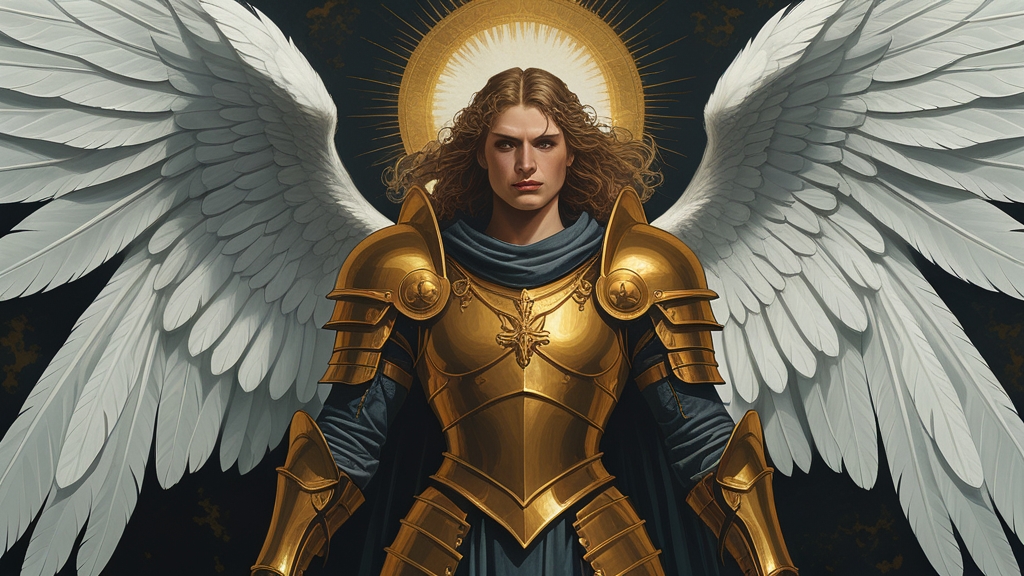
Who Is Sanguinius?
Sanguinius is the Primarch of the Blood Angels, the IX Legion of Space Marines, and he is widely regarded as the noblest and most beloved of all the Emperor’s sons. Gifted with magnificent angelic wings, extraordinary beauty, and a selfless courage that inspired loyalty in all who met him, Sanguinius was the only Primarch widely considered capable of replacing the Emperor should the need ever arise. His death at the hands of Horus during the Siege of Terra is one of the most significant events in Warhammer 40,000 history, and its consequences continue to shape the Blood Angels and their successor Chapters to this day.
Sanguinius represents the best of what the Primarchs could have been — compassionate yet powerful, humble yet inspiring, capable of terrible violence yet guided by a profound love for humanity. His sacrifice during the Siege of Terra was not merely a military act but a spiritual one, and the wound it left on his Legion transcends normal grief. The Black Rage that afflicts the Blood Angels — a genetic psychic echo of Sanguinius’s death — ensures that ten thousand years later, every Blood Angel who falls in battle relives their Primarch’s final, agonising moments.
Origins on Baal
Sanguinius’s gestation pod landed on Baal Secundus, one of the moons orbiting the rad-blasted desert world of Baal. The Baalite moons were among the harshest environments in the Imperium — irradiated wastelands populated by mutant tribes who fought constantly over meagre resources. Radiation storms, toxic dust, and mutated predators made simple survival a daily struggle for the human population.
The infant Primarch was found by the Blood, one of the more civilised tribes of Baal Secundus. Even as a baby, Sanguinius was extraordinary — his most distinctive feature was a pair of beautiful, functional angelic wings that sprouted from his back, a mutation that in the irradiated culture of Baal could have meant death. Many in the tribe argued that the winged infant was a mutant who should be killed, but the tribe’s leaders recognised something divine in the child and chose to raise him.
Sanguinius grew quickly, and as with all Primarchs, his superhuman abilities became apparent at a young age. But unlike many of his brothers, whose early displays of power were primarily martial, Sanguinius’s first great deeds were acts of compassion and protection. He defended the Blood tribe from mutant raiders, healed the sick with his presence, and inspired hope in a population that had known only desperation. When he eventually united the tribes of Baal Secundus under his rule, he did so as much through inspiration as through force of arms.
The people of Baal worshipped Sanguinius as an angel — a divine being sent to deliver them from suffering. This reverence was not unearned. Sanguinius led campaigns to reclaim the most irradiated regions, established stable settlements, mediated disputes between formerly warring tribes, and created a civilisation from the ruins of post-apocalyptic savagery. By the time the Emperor arrived, Sanguinius had transformed Baal Secundus from a death world of warring mutant tribes into a functioning, if harsh, society united by hope and shared purpose.
The Angel of the Great Crusade
Sanguinius’s reunion with the Emperor was one of the most profound moments of the Great Crusade. Where other Primarchs required contests of strength or political negotiation, Sanguinius is said to have simply knelt before the Emperor upon seeing Him, recognising his father instantly. The Emperor, in turn, is described as having shown a warmth toward Sanguinius that He displayed toward few of His other sons — though whether this was genuine affection or pragmatic manipulation remains one of the setting’s enduring ambiguities.
Given command of the IX Legion — renamed the Blood Angels — Sanguinius led them across the galaxy with a combination of martial excellence and inspiring leadership that made the Blood Angels one of the most celebrated Legions. The Angel fought at the forefront of his warriors, his wings carrying him above the battlefield like a divine figure from pre-Imperial mythology. His mere presence could turn the tide of a battle, as allies fought harder knowing the Angel was among them and enemies quailed before his terrible, beautiful fury.
The Blood Angels under Sanguinius were known for their artistic sensibility as much as their martial prowess. Sanguinius encouraged his sons to pursue beauty in all its forms — art, music, literature, architecture — as a counterbalance to the violence of their existence. The Blood Angels’ fortress-monastery on Baal became a gallery of extraordinary art, and many Blood Angels were as accomplished as artists and craftsmen as they were as warriors. This pursuit of beauty was not mere affectation but a deliberate strategy to maintain the Legion’s humanity in the face of a dark genetic flaw.
For Sanguinius carried a terrible secret: a genetic flaw in his gene-seed that caused some Blood Angels to succumb to an uncontrollable bloodlust known as the Red Thirst. Affected Marines lost all reason, becoming little more than feral predators consumed by an overwhelming desire to drink blood. Sanguinius was terrified that if the Emperor discovered this flaw, He would order the IX Legion destroyed — as had allegedly happened to the II and XI Legions. The Angel therefore hid the Red Thirst, working tirelessly to find a cure while concealing the worst cases from outside observation.
The Horus Heresy
The Horus Heresy placed Sanguinius in a uniquely painful position. Of all the Primarchs, he had been closest to Horus. The Warmaster and the Angel had shared a deep bond of mutual respect and affection, and Horus’s betrayal struck Sanguinius more personally than almost any other loyalist. The knowledge that his closest brother had turned against everything they had built together was a wound that cut deeper than any blade.
Sanguinius was also burdened by prophetic visions of his own death. His latent psychic abilities showed him glimpses of the future, and he foresaw that the Heresy would end with his death at Horus’s hands aboard the Warmaster’s flagship. This foreknowledge meant that Sanguinius went into the final battle knowing he would not survive — yet he went anyway, because his death was necessary to give the Emperor the chance to defeat Horus. This willing sacrifice, this acceptance of martyrdom for the sake of humanity, is what elevates Sanguinius from hero to legend.
Before the Siege of Terra, Sanguinius served as the Emperor Secundus during Guilliman’s Imperium Secundus experiment on Macragge. He also fought in the brutal campaign at Signus Prime, where the Blood Angels were lured into a trap by Chaos forces specifically designed to exploit the Red Thirst and drive the entire Legion into madness. Sanguinius faced the Greater Daemon Ka’Bandha in personal combat, and though grievously wounded, he defeated the daemon through sheer force of will — a feat that left psychic scars on the Blood Angels Legion that would merge with the later trauma of Sanguinius’s death to create the Black Rage.
The Siege of Terra
The Siege of Terra was the climactic battle of the Horus Heresy, and Sanguinius played a pivotal role in the defence of the Imperial Palace. As one of the three Primarchs present for the defence — alongside Rogal Dorn and Jaghatai Khan — Sanguinius served as the emotional heart of the loyalist resistance. While Dorn designed the fortifications and the Khan led rapid counterattacks, Sanguinius was the rallying point around which the defenders coalesced.
The most famous single act of the Siege — before the final confrontation with Horus — was Sanguinius’s defence of the Eternity Gate, the final portal to the inner sanctum of the Imperial Palace and the Emperor Himself. When the traitor forces breached the outer defences and threatened to overwhelm the last line of defence, Sanguinius stood alone before the Eternity Gate and held it against wave after wave of daemons, traitor Marines, and corrupted war machines. His last stand at the Eternity Gate is one of the most iconic images in all of Warhammer 40,000 — the Angel, wings spread, sword blazing, holding the line between humanity and oblivion.
When the Emperor chose to teleport aboard Horus’s flagship, the Vengeful Spirit, to confront the Warmaster directly, Sanguinius was among the party that accompanied Him. In the chaotic teleportation, the group was scattered throughout the ship, and Sanguinius reached Horus first. Alone, exhausted from the defence of the Eternity Gate, and armed with foreknowledge of his own death, the Angel confronted his fallen brother one final time.
Death at the Hands of Horus
The duel between Sanguinius and Horus aboard the Vengeful Spirit is the single most important personal combat in Warhammer 40,000 history. Horus, fully empowered by the four Chaos Gods, was at the absolute apex of his power — arguably the most powerful being in the galaxy at that moment, surpassing even the Emperor in raw might. Against this god-like figure, Sanguinius stood with nothing but his sword, his will, and the certain knowledge that he would die.
Sanguinius fought with everything he had. Despite the impossibility of his situation, the Angel wounded Horus — creating a crack in the Warmaster’s Chaos-blessed armour that the Emperor would later exploit. Some sources suggest that Horus offered Sanguinius a chance to join him, appealing to their old friendship and promising the Angel a place of honour in the new order. Sanguinius refused, remaining loyal to the last breath.
Horus killed Sanguinius. The exact manner varies between sources — some describe the Warmaster breaking the Angel’s back, others depict Sanguinius being run through by Horus’s great talon. What is consistent across all accounts is that Sanguinius died standing, still fighting, and that his death was not in vain. The crack he made in Horus’s armour — physical or spiritual — gave the Emperor the opening He needed to destroy the Warmaster once and for all.
When the Emperor found Sanguinius’s body, it is said that He wept — one of the only times the Master of Mankind is recorded as having shown grief. The Emperor then confronted Horus and, in a battle of psychic and physical might, destroyed the Warmaster utterly, but at the cost of His own mortal body. The Emperor was interred upon the Golden Throne, and the Imperium was saved — but the price was the lives of its two greatest champions.
The Black Rage Legacy
The Black Rage is the most significant and tragic consequence of Sanguinius’s death, and it is a curse that has haunted the Blood Angels and every one of their successor Chapters for ten thousand years. The Black Rage is a genetic psychic phenomenon in which a Blood Angel’s mind is overwhelmed by the echo of Sanguinius’s final moments — the despair, the fury, the agony of his death at Horus’s hands. Marines who succumb to the Black Rage lose their identity entirely, believing themselves to be Sanguinius in his last battle.
The Black Rage strikes randomly and without warning. A Marine who served faithfully for centuries can suddenly be overcome, and once the Rage takes hold, there is no cure and no recovery. Afflicted Marines are gathered into the Death Company — units of mad, grief-stricken warriors clad in black armour who are sent into the most dangerous battles as shock troops. They fight with the desperate fury of a dying Primarch, feeling no pain and showing no fear, and they are expected to die in battle rather than be allowed to degenerate further.
The Blood Angels’ pursuit of art and beauty — first encouraged by Sanguinius himself — takes on a poignant new meaning in light of the Black Rage. It is not mere aesthetic preference but a desperate attempt to stave off the madness, to maintain their humanity and their connection to the nobler aspects of their gene-father’s legacy rather than the horror of his death. Every painting a Blood Angel creates, every sculpture they carve, is an act of defiance against the genetic doom that awaits them.
For more on how the Blood Angels translate their tragic legacy into tabletop gameplay, visit our Blood Angels army guide.
Sanguinius’s Impact on the Setting
Sanguinius’s death resonates through every level of Warhammer 40,000’s setting and narrative. Within the Imperium, he is venerated as a martyr-saint, second only to the Emperor Himself in the devotion he inspires. The Sanguinala — the holiest day in the Imperial calendar — celebrates his sacrifice, and his image appears in churches, cathedrals, and shrines across a million worlds. He is the Imperium’s ideal, the perfect warrior-angel who gave his life so that humanity could endure.
For the Blood Angels and their successors, Sanguinius is everything — father, god, guiding star, and eternal source of both pride and grief. Every Blood Angel carries a fragment of their Primarch’s psychic echo within their gene-seed, and every Blood Angel knows that at any moment, that echo could consume them. They are simultaneously the most beautiful and the most cursed of all Space Marine Chapters, and this duality is entirely Sanguinius’s legacy.
Sanguinius also serves as a powerful thematic counterpoint to the grimdark setting. In a galaxy defined by cruelty, corruption, and hopelessness, Sanguinius represents the possibility of genuine heroism — of choosing to do the right thing even when it means certain death, of valuing beauty and compassion even in the darkest of times. His willing sacrifice at the Siege of Terra is perhaps the single most nobly heroic act in a setting that often seems designed to crush such nobility, and it endures as proof that even in the grim darkness of the far future, there can be light.
Among the Primarchs, Sanguinius’s death is unique in its finality and its impact. While other lost Primarchs might return — and in the cases of Guilliman and the Lion, already have — Sanguinius’s death appears to be permanent. He died not merely physically but gave his soul-essence in the confrontation with Horus, leaving nothing for Chaos to corrupt and nothing for the Imperium to resurrect. He is truly gone, and his absence is as powerful a narrative force as any living character’s presence.
Frequently Asked Questions
Could Sanguinius have defeated Horus?
Under normal circumstances, Sanguinius might have been able to match or defeat Horus, as he was considered one of the most powerful Primarchs in combat. However, at the time of their final duel, Horus was empowered by all four Chaos Gods simultaneously, making him virtually unstoppable. Additionally, Sanguinius was already exhausted from his last stand at the Eternity Gate. The odds were impossibly stacked against the Angel, and his death was essentially predetermined — but his resistance still created the weakness that allowed the Emperor to destroy Horus.
Is the Black Rage curable?
As of the current lore, the Black Rage has no known cure. Mephiston, the Blood Angels’ Chief Librarian, is the only known Marine to have overcome the Black Rage through sheer force of will, but his recovery has never been replicated. Various characters have sought cures over the millennia — including Corbulo, the Blood Angels’ Sanguinary High Priest — but none have succeeded. The Black Rage appears to be a fundamental psychic imprint in the Blood Angels’ gene-seed that cannot be removed without destroying what makes them Blood Angels.
Was Sanguinius the strongest Primarch?
Sanguinius is consistently portrayed as one of the top-tier combat Primarchs, with many lore sources placing him alongside Horus, the Lion, and Leman Russ as the deadliest warriors among the Emperor’s sons. His ability to fly gave him a unique tactical advantage, and his speed and grace in combat were unmatched. Many fans and lore scholars argue that in a fair fight, Sanguinius could have beaten any of his brothers — though this is a perennial debate with no definitive answer.
Why did Sanguinius hide the Red Thirst?
Sanguinius hid the Red Thirst because he feared the Emperor would order the IX Legion destroyed if the genetic flaw was discovered. This fear was not unfounded — two Legions (the II and XI) had already been eliminated during the Great Crusade, and the precedent for destroying flawed Legions existed. Sanguinius chose to hide the flaw and seek a cure privately, a decision that caused him great personal anguish but preserved his Legion’s existence.
Will Sanguinius ever return to the setting?
Sanguinius’s return is considered unlikely by most lore observers, as his death is one of the foundational pillars of the Warhammer 40,000 narrative. Unlike other missing Primarchs who disappeared or were placed in stasis, Sanguinius died definitively. Games Workshop has shown no indication of reversing this death, and doing so would undermine the emotional weight of his sacrifice and the narrative significance of the Black Rage. However, echoes and visions of Sanguinius continue to appear in the lore, keeping his presence felt without diminishing the impact of his death.
What is the difference between the Black Rage and the Red Thirst?
The Red Thirst and the Black Rage are two distinct but related genetic flaws in the Blood Angels’ gene-seed. The Red Thirst is the older flaw, present since the Legion’s founding — it manifests as an overwhelming desire to drink blood and can cause Marines to lose control in the heat of battle. The Black Rage, by contrast, was caused by Sanguinius’s death and involves a Marine’s mind being overwhelmed by the psychic echo of Sanguinius’s final moments. The Red Thirst is manageable and most Blood Angels live with it their entire lives, while the Black Rage is irreversible and invariably fatal.