
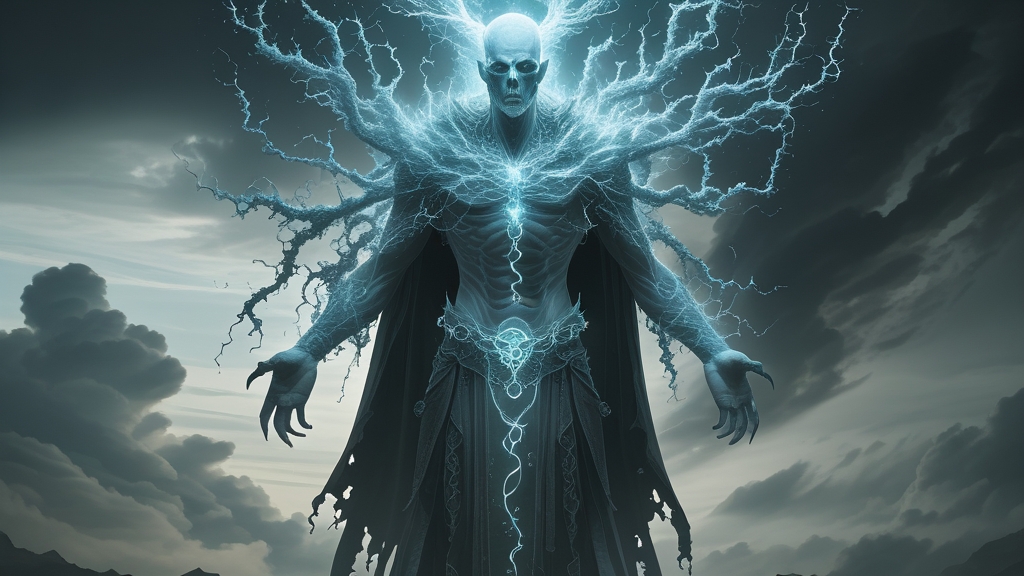
The Yncarne is the physical avatar of Ynnead, the partially-awakened Aeldari god of death. It manifests wherever Aeldari die, drawing power from their departing souls, and fights to fully awaken Ynnead so the Eldar can defeat Slaanesh. The Yncarne is not a daemon, not a construct, and not a mortal being — it is a fragment of divine will given form, a shard of a god that has not yet fully come into existence. It exists in a state between potential and reality, drawing closer to full manifestation with every Aeldari soul that passes from the material world.
The Yncarne’s existence represents the most radical hope the Aeldari race has known since the Fall — the possibility that their ancient enemy, the Chaos God Slaanesh who devours their souls, might be defeated not through military force or political alliance but through the birth of a new god. This hope is the driving force behind the Ynnari movement, and the Yncarne is its most visible and most powerful champion.
Understanding the Yncarne requires understanding the theological crisis at the heart of Aeldari civilisation — the question of what happens when an Aeldari dies, and whether there is any escape from Slaanesh’s eternal hunger.
What Is Ynnead and Why Does the Yncarne Exist?
Ynnead is the Aeldari god of death — a deity that exists in a state of partial awakening, sustained by the psychic energy of dead Aeldari souls. The concept of Ynnead emerged from an ancient Aeldari prophecy that foretold the birth of a new god from the collective death-energy of the Aeldari race. According to this prophecy, when enough Aeldari have died and their souls have been gathered, Ynnead will fully awaken and possess the power to destroy Slaanesh, freeing the Aeldari from the curse that has haunted them since the Fall.
The original interpretation of this prophecy was bleak — it suggested that Ynnead could only fully awaken when all Aeldari had died, meaning that the race’s salvation required its extinction. This interpretation made the prophecy a source of fatalistic despair rather than hope, and most Aeldari dismissed it as a cruel cosmic joke.
The emergence of Yvraine and the Ynnari movement offered a different interpretation. Yvraine — who died and was resurrected by Ynnead’s power — discovered that the god could be partially awakened without requiring the death of every Aeldari. The Yncarne was the most dramatic evidence of this partial awakening — a physical avatar of Ynnead that manifested in the material world, proving that the death god was real, was growing in power, and could intervene directly in the fate of the Aeldari race.
How Does the Yncarne Manifest?
The Yncarne’s method of manifestation is unique among the entities of the Warhammer 40k universe. Unlike daemons, which are summoned through rituals or Warp breaches, the Yncarne appears spontaneously wherever large numbers of Aeldari die. When Aeldari souls depart their bodies, the psychic energy released creates a focal point that draws the Yncarne into reality — it literally forms from the death-energy of the fallen, coalescing into physical form at the site of the greatest loss.
This means the Yncarne can appear anywhere in the galaxy without warning, teleporting from one battlefield to another as mass casualties create new anchoring points. One moment it might be fighting on a Craftworld under siege; the next, it vanishes and reappears on a distant world where Aeldari corsairs have been ambushed. This unpredictability makes the Yncarne both an invaluable ally and an unreliable one — it goes where death calls it, not where strategists deploy it.
The Yncarne’s physical form is a stunning and terrifying sight. It appears as a towering figure of shifting, semi-translucent energy, part solid flesh and part spectral light. Ghostly souls swirl around its body, the faces of dead Aeldari visible in the energy currents that compose its form. It carries a great sword — Vilith-zhar, the Sword of Souls — and its very presence on the battlefield causes nearby spirit stones to resonate and glow as the souls within them respond to their death god’s proximity.
What Are the Yncarne’s Powers?
The Yncarne possesses abilities that reflect its nature as an avatar of death. Its primary power is the ability to draw strength from death itself — every casualty on the battlefield, every departing soul, feeds the Yncarne’s power and heals its wounds. This creates a paradoxical situation for enemies: the more damage they inflict on the Yncarne’s allies, the stronger the Yncarne becomes. In a prolonged battle with heavy casualties, the Yncarne can become virtually unstoppable as the accumulating death-energy pushes its power to extraordinary levels.
Vilith-zhar, the Sword of Souls, is a weapon of immense power that is less a physical sword and more a concentrated expression of death-energy given cutting form. It can sever the connection between a soul and its body, kill daemons by disrupting their Warp-essence, and even damage beings that are normally immune to physical weapons. Against Slaaneshi daemons in particular, the Sword of Souls is devastatingly effective — the death-energy it channels is the antithesis of Slaanesh’s consumptive power.
The Yncarne can also manipulate the boundary between life and death in ways that other psykers cannot. It can temporarily resurrect fallen Aeldari warriors, pulling their souls back from the edge of Slaanesh’s grasp and returning them to their bodies for a brief period. This ability is not true resurrection — the returned warriors are sustained by Ynnead’s power rather than their own life force, and they will inevitably fall again — but it can turn the tide of a battle by bringing dead warriors back into the fight at a critical moment.
What Is the Yncarne’s Role Among the Ynnari?
The Yncarne serves as the Ynnari’s most powerful warrior and their most compelling proof of concept. The Ynnari movement — led by Yvraine, the Prophet of Ynnead, and guided by the Visarch, her champion — is a cross-faction Aeldari alliance dedicated to fully awakening Ynnead and destroying Slaanesh. The Yncarne’s existence proves that Ynnead is real and that the death god’s power is growing, which gives the Ynnari’s message credibility that words alone could never provide.
However, the Yncarne is not a simple soldier to be deployed at Yvraine’s command. It is a fragment of a god, and its priorities do not always align with mortal strategy. The Yncarne goes where death calls — it manifests at sites of Aeldari mass death regardless of whether that location is strategically important to the Ynnari’s plans. This can create tactical complications, as the Yncarne might vanish from a battle the Ynnari are fighting to appear at a distant catastrophe that serves no strategic purpose.
The relationship between Yvraine and the Yncarne is one of mutual need rather than command and obedience. Yvraine provides the political and strategic leadership that the Ynnari movement requires — she recruits followers, negotiates alliances, and directs campaigns. The Yncarne provides the raw divine power that proves Ynnead is real and growing. Together, they represent the two essential elements of the Ynnari project: mortal agency and divine intervention.
How Do Other Aeldari Factions View the Yncarne?
The Yncarne — and the Ynnari movement it represents — has divided Aeldari opinion sharply. The Craftworld Aeldari are split between those who see the Ynnari as the race’s last best hope and those who view them as dangerous fanatics pursuing a heretical theology. The more conservative Craftworlds — particularly those with strong traditions of ancestor worship through spirit stones — are deeply uncomfortable with the idea of feeding souls to a death god, even one that promises salvation.
The Drukhari of Commorragh are largely hostile to the Ynnari. The Drukhari survive by feeding on the pain of others — if Slaanesh were destroyed, the fundamental dynamic that sustains their civilisation would change in unpredictable ways. Asdrubael Vect has branded the Ynnari as enemies and has actively persecuted their followers in Commorragh, seeing them as a threat to his power and to the social order he has spent millennia constructing.
The Harlequins occupy a more ambiguous position. As followers of Cegorach, the Laughing God, the Harlequins have their own perspective on the cosmic drama between the Aeldari and Slaanesh. Some Harlequin masques support the Ynnari and the Yncarne, seeing Ynnead as a potential ally for Cegorach. Others view the death god with suspicion, uncertain whether Ynnead’s awakening would truly benefit the Aeldari or simply replace one cosmic threat with another.
What Is the Yncarne’s Significance in the Wider 40k Narrative?
The Yncarne represents one of the most significant narrative developments in recent Warhammer 40k history — the possibility that the cosmic order of the setting might fundamentally change. The relationship between the Aeldari and Slaanesh has been a fixed feature of the 40k universe since its inception. The idea that this relationship might be broken — that a new god could arise to challenge and potentially destroy one of the four great Chaos Gods — is revolutionary.
The Yncarne also plays a crucial role in one of the most important events in recent 40k lore: the resurrection of Roboute Guilliman. It was the Ynnari — with the Yncarne’s divine power — who provided the energy necessary to heal Guilliman’s mortal wound and restore the Primarch to life. This act created an alliance of convenience between the Ynnari and the Imperium, with Guilliman owing a personal debt to Yvraine and her followers.
This alliance is fragile and politically complicated. The Imperium is officially hostile to all xenos, and many Imperial leaders view any cooperation with the Aeldari as heresy. Guilliman’s willingness to work with the Ynnari is one of the more controversial aspects of his return, and it creates tension within the Imperium’s leadership. The Yncarne’s role in saving Guilliman makes it simultaneously one of the Imperium’s most important allies and one of its most theologically dangerous threats.
Frequently Asked Questions
Is the Yncarne a daemon?
No. While the Yncarne shares some superficial similarities with daemons — it is a Warp entity that manifests in the material world — it is fundamentally different. Daemons are fragments of the Chaos Gods, born from negative emotions and sustained by the corruption of reality. The Yncarne is a fragment of Ynnead, sustained by the death-energy of Aeldari souls. Its nature is opposed to Chaos rather than aligned with it, and its ultimate purpose is the destruction of a Chaos God, not the spread of corruption.
Can the Yncarne die?
The Yncarne can be banished from the material world — its physical form can be destroyed by sufficient force. However, as long as Ynnead exists and Aeldari continue to die, the Yncarne will eventually re-manifest. It is not truly killable in the conventional sense because it is not a mortal being — it is an expression of divine will that reforms whenever the conditions for its manifestation are met.
What is the Sword of Souls?
Vilith-zhar, the Sword of Souls, is the Yncarne’s weapon — a blade formed from concentrated death-energy that can cut through physical matter and Warp-stuff alike. It is particularly effective against daemons and Warp entities, and it can sever the connection between a soul and its body. The sword is not a separate artefact — it is part of the Yncarne, manifesting alongside the avatar whenever it appears.
Did the Yncarne really help resurrect Guilliman?
Yes. The Ynnari, with the Yncarne’s divine power, provided the energy necessary to heal Roboute Guilliman’s mortal wound and restore him to life. This event is one of the most significant in recent 40k lore, as it created a precedent for cooperation between the Imperium and the Aeldari and demonstrated that Ynnead’s power over death could be used to restore life as well as take it.
What is the difference between the Yncarne and the Avatar of Khaine?
They are avatars of different gods. The Avatar of Khaine is a shard of Khaine, the Aeldari war god, kept dormant in a craftworld’s heart and awakened by a Young King’s sacrifice. The Yncarne is the avatar of Ynnead, the emerging god of the dead, and it manifests wherever many Aeldari die. The Avatar embodies war and is bound to one craftworld; the Yncarne can appear anywhere.
Does the Yncarne have a model?
Yes. The Yncarne has its own miniature, released in 2017 with the Gathering Storm campaign alongside Yvraine and the Visarch. It shows the avatar rising from swirling spirit energy with the Sword of Souls, Vilith-zhar. The three models together form the Triumvirate of Ynnead, and it’s a striking centrepiece for an Aeldari or Ynnari collection.
Related Content
- Craftworlds Army Guide — explore the Aeldari faction
- The Chaos Gods Explained — learn about the Dark Gods including Slaanesh
- Who Is Roboute Guilliman? — learn about the Primarch the Ynnari resurrected
- Best Warhammer Books to Read — Fiction Guide — find great Warhammer novels