
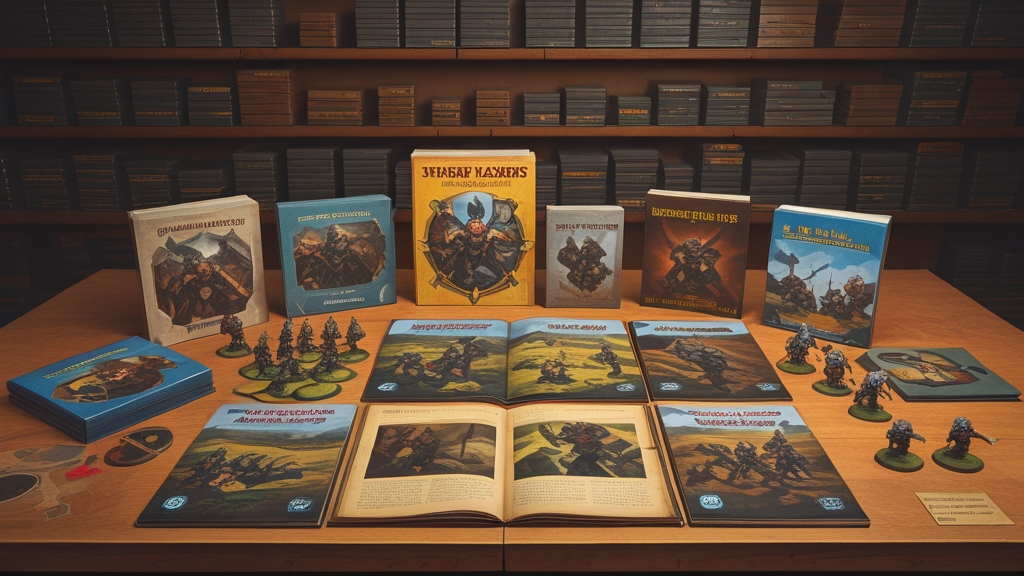
Warhammer was created by Rick Priestley and Bryan Ansell at Games Workshop, a British company founded in 1975 by Ian Livingstone, Steve Jackson, and John Peake. GW started as a board game importer before creating their own miniatures games.
The question “who made Warhammer?” has a deceptively complex answer. Unlike most entertainment franchises, which can be attributed to a single creator — Tolkien wrote Lord of the Rings, George Lucas created Star Wars — Warhammer was the product of a collaborative ecosystem of designers, sculptors, writers, and business leaders who collectively built one of the most successful creative franchises in history. The story of Warhammer’s creation is inseparable from the story of Games Workshop itself.
Who Founded Games Workshop?
Games Workshop was founded in 1975 by three friends: Ian Livingstone, Steve Jackson, and John Peake. The company began in Livingstone’s flat in Shepherd’s Bush, London, as a small-scale board game distribution business.
Ian Livingstone was a lifelong game enthusiast who saw a business opportunity in the growing tabletop gaming market. He would go on to become one of the most influential figures in British gaming, co-creating the Fighting Fantasy gamebook series (which sold over 20 million copies worldwide) and serving as Games Workshop’s chairman during its critical growth years. Today, Livingstone is a CBE and remains a prominent voice in the UK gaming industry.
Steve Jackson (not to be confused with the American game designer of the same name) was Livingstone’s co-founder and co-creator of Fighting Fantasy. Jackson contributed to Games Workshop’s early game design and publishing before eventually parting ways with the company to pursue other projects, including the creation of Lionhead Studios with Peter Molyneux.
John Peake was the third co-founder, though he departed the company early in its history and is less well-known than Livingstone and Jackson. His role was primarily in the initial business setup and early operations.
The founding trio’s first major success was securing the UK distribution rights for Dungeons & Dragons, which had been created by Gary Gygax and Dave Arneson in the United States in 1974. D&D was exploding in popularity in America, and Livingstone and Jackson recognised the opportunity to bring it to the British market. This decision proved transformative — D&D sales funded Games Workshop’s growth and introduced the company to the tabletop gaming community that would later form Warhammer’s core audience.
Who Designed the First Warhammer Game?
The first edition of Warhammer Fantasy Battles (1983) was primarily designed by Rick Priestley and Richard Halliwell, with significant creative input from Bryan Ansell.
Rick Priestley is arguably the single most important individual in Warhammer’s creation. A talented game designer who joined Games Workshop in the early 1980s, Priestley was the primary designer of both Warhammer Fantasy Battles (1983) and Warhammer 40,000: Rogue Trader (1987). He created the core rules systems, contributed extensively to the settings, and shaped the fundamental identity of both games. Priestley’s design philosophy — combining accessible core mechanics with rich setting detail and characterful army rules — remains the template for Warhammer game design to this day. After decades at Games Workshop, Priestley eventually left the company but continues to design tabletop games, including the acclaimed Bolt Action World War II wargame.
Richard Halliwell was Priestley’s primary collaborator on early Warhammer, contributing to both the rules design and the setting development. Halliwell’s influence was particularly significant in the darker, more satirical elements of early Warhammer — the black humour, the moral ambiguity, and the sense that the universe was fundamentally hostile to its inhabitants. He also designed several other Games Workshop games, including the influential Space Hulk. Halliwell passed away in 2019, and his contributions to the hobby are widely recognised as foundational.
Bryan Ansell was the creative and business leader who made Warhammer possible. Ansell had founded Citadel Miniatures, a company that manufactured metal miniatures for tabletop gaming. When Citadel merged with Games Workshop, Ansell became the driving force behind the company’s transition from game distributor to game creator. His vision was to create an integrated product — rules, setting, and miniatures designed together as a single package — that would differentiate Games Workshop from every other company in the market. This vision became the foundation of Games Workshop’s business model and remains the core of the company’s strategy over 40 years later.
Who Else Shaped Warhammer?
While Priestley, Halliwell, and Ansell were the primary creators, Warhammer was shaped by dozens of talented individuals whose contributions were essential to the franchise’s success.
Jervis Johnson was one of Games Workshop’s most prolific game designers, contributing to multiple editions of both Warhammer Fantasy and 40k. Johnson was instrumental in refining the rules systems and was a key designer on Blood Bowl, the beloved Warhammer-themed fantasy football game. He also wrote extensively for White Dwarf and was known for his thoughtful, philosophical approach to game design.
Andy Chambers was the lead designer for Warhammer 40,000 during its 3rd and 4th editions (1998-2004) — the period many fans consider the golden age of 40k rules design. Chambers was responsible for streamlining 40k’s rules, creating the codex format that is still used today, and establishing the competitive framework that supports the modern tournament scene. His design philosophy balanced narrative flavour with competitive balance in a way that few designers have matched.
Jes Goodwin is perhaps the most influential miniatures designer in history. His sculpts defined the look of Warhammer 40,000 — the iconic Space Marine power armour, the Eldar aesthetic, and countless other designs that have become synonymous with the franchise. Goodwin’s ability to create designs that are both visually striking and practically mouldable established the standard for miniatures design worldwide.
John Blanche is the artist whose dark, atmospheric illustrations defined the visual identity of Warhammer. Blanche’s art — characterised by its grimdark palette, intricate detail, and nightmarish imagery — established the tone that separates Warhammer from cleaner, more heroic fantasy and science fiction settings. His influence on the franchise’s visual identity cannot be overstated; when people think of what Warhammer “looks like,” they are usually thinking of John Blanche’s vision.
The Perry Twins — Alan and Michael Perry — were among the most prolific and talented miniatures sculptors in Games Workshop’s history. Their work defined the look of Warhammer Fantasy in particular, creating the iconic rank-and-file soldiers, knights, and monsters that populated the Old World for decades. The Perrys eventually left Games Workshop to found their own company (Perry Miniatures) but their legacy is embedded in the DNA of Warhammer Fantasy.
How Did Games Workshop Evolve as a Company?
Games Workshop’s evolution from a flat in Shepherd’s Bush to a FTSE-listed corporation is one of the most remarkable business stories in British entertainment.
The early years (1975-1982) were characterised by scrappy entrepreneurialism. The founders imported and distributed games, published White Dwarf magazine, and opened small retail stores. Revenue was modest, and the company operated with minimal staff and resources.
The Warhammer era (1983-1990) saw explosive growth. The launch of Warhammer Fantasy in 1983 and Warhammer 40,000 in 1987 gave Games Workshop its own intellectual property and a vertically integrated business model — they designed the games, manufactured the miniatures, and sold them through their own stores. This model proved enormously profitable and differentiated GW from competitors who only operated in one part of the value chain.
The public company era (1991-2000) saw Games Workshop float on the London Stock Exchange and expand internationally. The company opened stores across Europe, North America, and Australasia, building a global retail presence. This period also saw the founding of Black Library (1997) and the expansion into licensed video games.
The modern era (2000-present) has been characterised by continued growth, the transition from metal to plastic miniatures, the rise of the Horus Heresy as a publishing phenomenon, the controversial End Times and launch of Age of Sigmar, and the explosive growth of the 2020s driven by pandemic hobbyists and mainstream cultural penetration. Under CEO Kevin Rountree (from 2015), Games Workshop has reached new heights of profitability and cultural relevance.
What Is Rick Priestley’s Legacy?
Rick Priestley’s contribution to tabletop gaming is difficult to overstate. He designed the two most successful miniatures wargames ever created — Warhammer Fantasy Battles and Warhammer 40,000 — and in doing so, essentially created the modern miniatures wargaming industry.
Before Warhammer, miniatures wargaming was primarily a historical hobby — recreating Napoleonic battles, World War II engagements, and ancient conflicts with carefully painted miniatures. Priestley’s innovation was to apply wargaming mechanics to an original fantasy and science fiction setting, creating games that combined the strategic depth of traditional wargaming with the narrative appeal of fantasy literature and the visual spectacle of detailed miniatures.
Priestley’s design philosophy — games should be fun first, competitive second, and should always serve the narrative of the setting — has influenced virtually every miniatures wargame designed since. Even competitors who have tried to differentiate themselves from Games Workshop have built upon the foundations that Priestley laid.
After leaving Games Workshop, Priestley continued to design games, including Bolt Action (a World War II wargame published by Warlord Games) and Beyond the Gates of Antares (a science fiction wargame). He remains an active and respected figure in the tabletop gaming community, frequently attending events and conventions where he is treated with the reverence due to the man who, more than any other individual, created Warhammer.
What Is John Blanche’s Influence?
If Rick Priestley defined how Warhammer plays, John Blanche defined how it looks. Blanche’s artwork — dark, atmospheric, heavily detailed, and unmistakably his own — established the visual language of the Warhammer universe and has influenced generations of artists, miniatures painters, and game designers.
Blanche’s style is often described as “grimdark” — a term that was itself coined from the Warhammer 40,000 tagline “In the grim darkness of the far future, there is only war.” His paintings are characterised by muted, earthy palettes punctuated by vivid reds and golds, intricate Gothic architecture, tortured human figures, and an overwhelming sense of scale and menace. His work for Games Workshop spans decades and includes iconic pieces that have become synonymous with the franchise.
Beyond his published artwork, Blanche has been enormously influential in the “Blanchitsu” or “INQ28” miniatures painting community — hobbyists who create dark, atmospheric miniatures inspired by Blanche’s art style rather than the cleaner, brighter “box art” painting style promoted by Games Workshop’s official painting guides. This community has become one of the most creative and influential subcultures within the Warhammer hobby.
Frequently Asked Questions
Is Rick Priestley still involved with Warhammer?
No. Rick Priestley left Games Workshop and no longer works on Warhammer products. He continues to design tabletop games through his association with Warlord Games and other publishers. However, his foundational work on both Warhammer Fantasy and 40k remains the basis of the games as they exist today, and his influence on the franchise is permanent and irreplaceable.
Are Ian Livingstone and Steve Jackson still involved with Games Workshop?
Ian Livingstone served as Games Workshop’s chairman for many years and remains connected to the company as a non-executive director emeritus. Steve Jackson left the company much earlier and has pursued other ventures in the gaming industry. Neither is involved in day-to-day operations or game design for Games Workshop.
Who runs Games Workshop today?
Games Workshop is led by CEO Kevin Rountree, who has been in the role since 2015. Under Rountree’s leadership, the company has achieved record revenues, expanded its licensing programme, and secured the transformative Amazon Studios deal. The current design studio is led by a team of designers, sculptors, and lore writers who continue to develop both Warhammer 40,000 and Age of Sigmar.
Did one person create Warhammer?
No. While Rick Priestley is often credited as the primary creator, Warhammer was fundamentally a collaborative creation. Bryan Ansell provided the vision and business infrastructure, Richard Halliwell co-designed the rules, Jes Goodwin designed the miniatures, John Blanche created the visual identity, and dozens of other designers, writers, artists, and sculptors contributed to the franchise over the decades. Warhammer is greater than any single creator.
Where is Games Workshop based?
Games Workshop’s headquarters are in Nottingham, England, where the company has been based since the 1980s. The Nottingham headquarters houses the design studio (known as “Warhammer World”), the company’s largest retail and gaming venue, and the administrative offices. Manufacturing is also based in the Nottingham area, with Games Workshop producing most of its miniatures in the UK.