
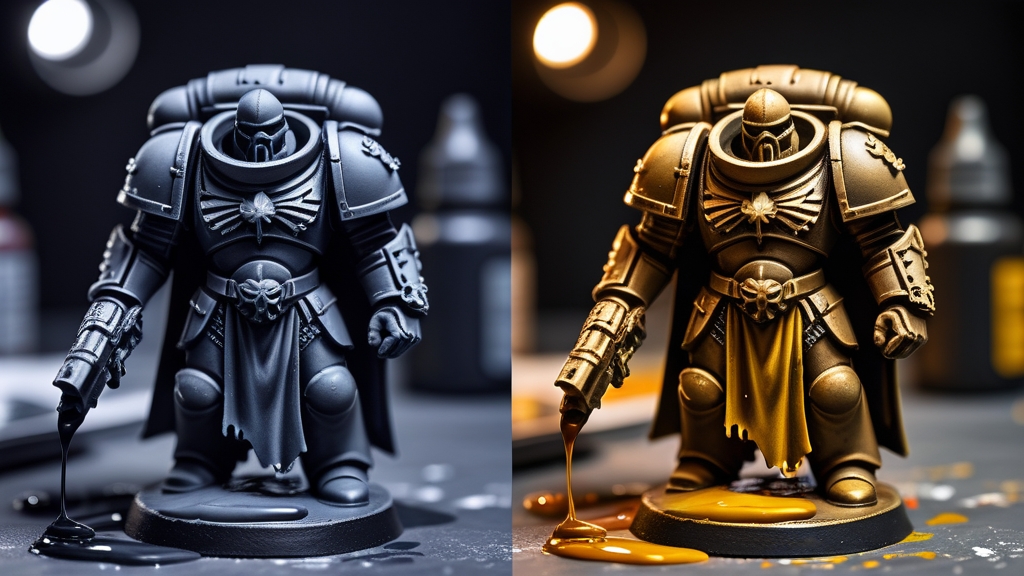
Washing (or shading) is applying a thin, dark-tinted paint that flows into recesses and gaps on a model, creating instant shadows and definition. Nuln Oil and Agrax Earthshade are the two most important washes in miniature painting — sometimes called “liquid talent” because of how dramatically they improve a model’s appearance.
If thinning paints is the most important skill, washing is the most immediately rewarding technique. A single coat of wash over a basecoated model can transform it from flat and toy-like to detailed and three-dimensional in minutes. Washes are the great equaliser — they make beginners look competent and experienced painters look exceptional.
This guide explains how washes work, when to use each type, and how to avoid the common pitfalls that trip up new painters.
How Washes Work
A wash (also called a shade) is paint thinned to an extremely watery consistency with added flow improver and medium. When applied over a model, gravity and surface tension pull the pigment into recesses — the gaps between armour plates, the folds of cloth, the crevices around rivets and details. Raised surfaces retain less pigment, staying closer to the original base colour.
The result is automatic shadow: dark areas in recesses, lighter areas on raised surfaces. This mimics how real light works — shadows form in gaps and crevices where light cannot reach. On a 28mm miniature, this effect adds enormous visual depth that would take hours to achieve with careful brush-painting.
Nuln Oil vs Agrax Earthshade: The Essential Two
While Games Workshop produces a range of shade paints, two dominate miniature painting:
Nuln Oil (Black Shade)
- Colour: Cool black/dark grey
- Best for: Metals, silver and steel armour, dark colours (blues, blacks, greys), weapons, mechanical details
- Effect: Creates cold, sharp shadows. Adds a grimy, industrial feel
- Use on: Space Marines, vehicles, guns, chainmail, anything mechanical or metallic
Agrax Earthshade (Brown Shade)
- Colour: Warm dark brown
- Best for: Skin, leather, bone, warm colours (reds, oranges, yellows, browns), gold, cloth
- Effect: Creates warm, natural shadows. Adds a weathered, organic feel
- Use on: Faces, fur, parchment, leather straps, wooden shields, gold armour, Stormcast Eternals
A useful rule of thumb: Nuln Oil for cold, metallic, and mechanical things; Agrax Earthshade for warm, organic, and natural things. Many painters keep both on their desk at all times and reach for one or the other instinctively.
Other Useful Washes
- Reikland Fleshshade — The go-to for skin tones, especially Caucasian flesh. Warmer and subtler than Agrax
- Drakenhof Nightshade — Blue shade, excellent for blue armour, cloth, and magical effects
- Carroburg Crimson — Red shade for red armour, wounds, and warm-toned skin
- Biel-Tan Green — Green shade for Ork skin, plants, and green armour
- Seraphim Sepia — Subtle warm shade for bone, parchment, and blonde hair
All-Over Wash vs Pin Washing vs Recess Shading
There are three main approaches to applying washes, each with different levels of control and results:
All-Over Wash
The simplest method: slather wash across the entire model surface. The wash flows into recesses naturally. This is fast and effective but darkens everything — including raised surfaces that should stay bright. Good for tabletop quality and beginners. Many speed-painting methods use an all-over wash as the core shading step.
Pin Washing
A more controlled method: load a fine brush with wash and touch it precisely into the recesses and panel lines. Capillary action pulls the wash along the recess. The raised surfaces stay completely clean. Takes longer but produces much cleaner results. Popular for vehicles, large armour panels, and competition pieces.
Recess Shading
A middle ground: apply wash carefully into recesses and along edges but don’t worry about perfect precision. Let the wash flow into gaps and crevices while keeping it mostly off flat surfaces. Faster than pin washing but cleaner than all-over. This is what most intermediate painters gravitate toward.
How to Apply a Wash: Step by Step
- Ensure your basecoat is fully dry — Wash over wet paint creates muddy, uncontrollable mess
- Shake the wash bottle — Washes can separate in the pot. Give it a good shake before each use
- Load your brush — Use a medium-to-large brush (size 1 or 2). You want enough wash to flow but not so much it drips. Wick excess off on the pot rim or a paper towel
- Apply to the model — For all-over, brush it across every surface in smooth strokes. For pin washing, touch the brush tip to recesses and let capillary action do the work
- Guide the wash — Use your brush to move pooling wash away from flat surfaces and into recesses. Don’t let large pools form on flat areas
- Let it dry completely — This is critical. Don’t touch the wash while it’s drying. It takes 15-30 minutes for a wash to fully dry. Moving it around while semi-dry creates ugly tide marks
Common Wash Mistakes and How to Fix Them
Pooling
The most common problem. Wash collects in large pools on flat surfaces — shoulder pads, cloaks, vehicle panels — creating dark blotches instead of controlled shadows. Fix: wick away excess with a dry brush immediately after application. Prevention: use less wash on your brush and guide pooling wash into recesses.
Coffee Staining
Named for its resemblance to a dried coffee ring. When wash dries on a flat surface, the edges dry first, pulling pigment to the perimeter and leaving a dark ring with a lighter centre. Fix: apply a thin layer of your basecoat back over the flat surface, leaving the wash in the recesses. Prevention: keep wash out of flat areas or use recess shading technique.
Frosting
Some washes (particularly older formulations) can dry with a slightly glossy or frosted finish. Fix: apply a matte varnish coat after all painting is complete. Prevention: shake the wash thoroughly and apply in thin layers rather than thick pools.
Over-darkening
Applying too much wash or multiple coats makes the model look dirty and dark rather than shaded. Fix: re-apply basecoat colour to raised surfaces, leaving wash only in recesses (this is called “re-establishing the basecoat”). Prevention: one controlled coat is usually sufficient.
Cleaning Up After a Wash
After your wash dries, you will often want to clean up by re-applying your basecoat colour to the raised surfaces. This step — sometimes called “layering back up” — restores brightness to flat panels and leaves the dark wash visible only in recesses where you want shadows.
This cleanup step is what separates a good paint job from a great one. The process is:
- Take your original basecoat colour
- Thin it slightly
- Carefully paint only the raised areas and flat panels, avoiding the recesses
- The result: crisp dark lines in recesses, clean bright colour on surfaces
Using Washes on Different Surfaces
Metallic Surfaces
Washes over metallics produce spectacular results. Nuln Oil over Leadbelcher creates convincing steel. Agrax Earthshade over Retributor Armour makes rich, aged gold. The wash settles into the brush-stroked texture of metallics, creating instant weathering and depth.
Skin
Reikland Fleshshade is the standard for Caucasian skin. For darker skin tones, Agrax Earthshade or even thinned Nuln Oil works well. Apply carefully to eye sockets, around the nose, between fingers, and under the chin — anywhere shadow would naturally fall on a face.
Cloth and Fabric
Washes excel on sculpted cloth because fabric naturally has deep folds and raised ridges. Apply wash across the entire cloth area and gravity does the work — pigment flows into folds while ridges stay light. Agrax for natural fabrics, Nuln Oil for dark robes.
Vehicles and Large Surfaces
Large flat surfaces are where washes cause the most problems (pooling, coffee staining). For vehicles, pin washing along panel lines and around rivets is strongly recommended over all-over application. Use a fine brush and let capillary action pull the wash along recessed lines.
What Is the Difference Between a Wash and Contrast Paint?
Washes are designed to add shadow to an already-painted surface — they work on top of a basecoat. Contrast paints are designed to act as basecoat and shade in one step — they go directly over a light primer (usually white or light grey). Contrast paints have more pigment and create both shadow and colour simultaneously, while washes add only shadow to existing colour. You can use both on the same model — many painters basecoat some areas and use Contrast on others.
Can You Make Your Own Washes?
Yes — a DIY wash is simply acrylic paint thinned significantly with water and a drop of flow improver or dish soap (to break surface tension). Mix roughly 1 part paint to 5-10 parts water plus a tiny drop of flow medium. Homemade washes are less controlled than commercial products but work well in a pinch and allow custom colours. Many experienced painters make their own to match specific colour schemes.
Should You Varnish Before Washing?
Some painters apply a gloss varnish before washing, especially on vehicles and large flat areas. The smooth, non-porous gloss surface helps wash flow directly into recesses without clinging to flat areas, virtually eliminating coffee staining. After the wash dries, a matte varnish restores the normal finish. This technique adds two extra steps but produces extremely clean results and is standard practice for vehicle painters.
Frequently Asked Questions
Which wash should I buy first?
Nuln Oil and Agrax Earthshade. These two cover 80% of all washing situations. If you can only buy one, Agrax Earthshade is slightly more versatile as it works on both warm and neutral colours without looking too stark.
Can I use too much wash?
Yes. Over-washing is a common beginner trap. One controlled coat is almost always sufficient. If you feel the shadows aren’t dark enough, try cleaning up with the basecoat first — the increased contrast between bright surface and dark recess might be all you need.
Should I thin my washes?
Generally, no — washes are pre-thinned to the correct consistency. However, for recess shading you can thin them further with Lahmian Medium (not water) for more subtle shadows. Water can break the wash’s flow properties.
How long should I wait for a wash to dry?
At least 20-30 minutes, longer in humid environments. The wash may look dry on the surface but still be wet in deep recesses. Painting over a semi-dry wash creates ugly marks. When in doubt, wait longer.
Do washes work on Contrast paints?
Yes, washes can be applied over dried Contrast paint to add extra shadow definition. This is useful when the Contrast paint’s built-in shading isn’t dark enough for your taste. Just ensure the Contrast layer is completely dry first.
What is the difference between a wash and a glaze?
A wash is thin, dark paint designed to run into recesses and create shadow. A glaze is a very thin, transparent layer of colour brushed evenly over an area to tint it or smooth transitions, without pooling in the recesses. You can turn many paints into a glaze by thinning them heavily with Lahmian Medium.
Should I wash before or after drybrushing?
Wash first, then drybrush. The wash darkens the recesses, and the drybrush then picks out the raised edges and textures again with a lighter colour. Drybrushing first and washing afterwards tends to dull the highlights you’ve just added, although a light wash can blend a drybrush that’s too stark.
Is Army Painter Quickshade the same as a wash?
Not quite. Quickshade is a tinted, varnish-based dip that shades the model and seals it in one step. You usually brush it on, let it dry, then spray matte varnish to remove the shine. It’s very fast for big armies but less controlled than a wash, and the original solvent-based dip can’t be thinned with water.
Related Content
- What Is Warhammer 40k — introduction to the Warhammer 40K universe
- Warhammer Painting for Beginners — Everything You Need — essential painting guide for new hobbyists
- How Does Morale Work in Warhammer 40k? — Battle-shock Explained — related content on a similar topic
- What Are Stratagems in Warhammer 40k? — Rules Guide — related content on a similar topic