
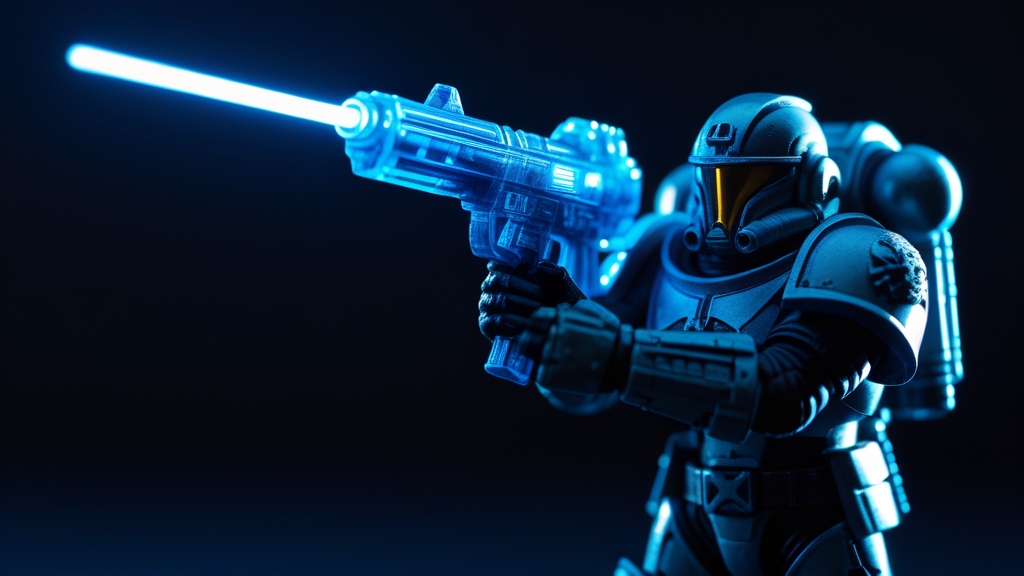
Object Source Lighting, or OSL, is the technique of painting the glow that a light source casts onto everything around it — a plasma coil lighting up a Space Marine’s gauntlet, a glowing sword underlighting a face, or warpfire spilling across a base. Done well, OSL is one of the most eye-catching effects in the hobby because it makes a static model look genuinely lit from within.
The Core Principle
Light is brightest closest to its source and fades quickly with distance. Everything you paint should obey that single rule: surfaces near the glow are strongly coloured, surfaces further away receive only a faint tint, and areas facing away from the light stay dark. Get the falloff right and the illusion sells itself.
What You Will Need
- Thinned layer paints or glazes in your chosen light colour (blue, green and orange are the classics)
- A glaze medium to build colour up gradually
- A fine detail brush and a steady hand
Step 1: Plan the Light Source
Decide exactly where the light comes from before you touch a brush, and commit to it. Inconsistent direction is the single most common thing that breaks OSL.
Step 2: Build the Glow in Thin Layers
Glaze your light colour onto the surfaces nearest the source, then apply progressively fewer, smaller layers as you move outward. Many thin coats give you smooth, controllable falloff; a single thick coat looks like a stain. Reserve the brightest, near-white highlight for the source itself and the surfaces almost touching it.
Step 3: Respect the Shadows
Just as important as adding light is leaving darkness. Keep the faces and surfaces turned away from the source in shadow — the contrast between the lit and unlit sides is what creates the drama.
Step 4: Light the Base
For a fully convincing effect, let the glow spill onto the base and any nearby models, so the light belongs to the whole scene rather than floating on one part. This pairs perfectly with effects like lava bases.
OSL rewards patience and planning more than raw brush skill. Start with a bright, obvious source such as a power weapon, keep your paints thin, and let the falloff do the work.
Frequently Asked Questions
Is object source lighting hard for beginners?
It’s easier than it looks if you start small. A glowing power weapon, eye lenses or a plasma coil is a good first project, because the light only needs to spread a short distance. Keep your paints thin, commit to one light direction and build the glow over several glazes rather than trying to get it in one coat.
Can I paint OSL with an airbrush?
Yes. An airbrush is very good for OSL because it makes smooth, soft gradients. Spray thin light colour close to the source and let it fade outward, then tidy up and add the brightest highlights by brush. Mask or shield nearby areas if you want the shadowed side to stay dark.
Does OSL work better on dark or light surfaces?
Dark surfaces. A glow is all about contrast, so light shows up most dramatically on black, dark blue or deep green areas and is much harder to sell on white or yellow. If your scheme is bright, darken the area around the light source a little first so the glow has something to stand out against.
What colour should I use for the glow on different surfaces?
Mix the light colour into the surface colour rather than painting pure glow over everything. On red armour lit by a green plasma coil, for example, the lit areas shift towards a muddy yellow-green, not pure green. Blending the two keeps the effect believable, and the purest, brightest tone stays on or right next to the light source.
Related Content
- Warhammer Painting for Beginners — Everything You Need — essential painting guide for new hobbyists
- Best Paints for Warhammer — Complete Comparison Guide — recommended paints for Warhammer miniatures
- How to Paint Rust Effects on Miniatures — Complete Guide — related painting technique and tutorial
- Drybrushing Tutorial — Fast Painting for Warhammer — popular drybrushing technique tutorial