
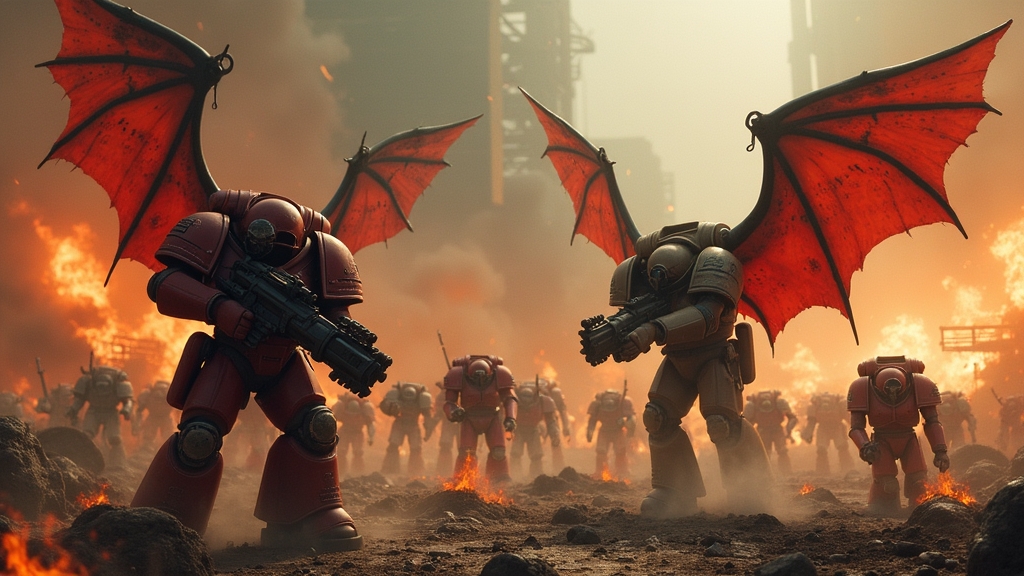
Part of our Blood Angels hub: every Blood Angels guide, lore page and painting tutorial in one place.
Why does the Armageddon box pit Blood Angels against Orks? The 11th Edition launch set returns Warhammer 40,000 to Armageddon — the war-torn hive world where the Ork warlord Ghazghkull Thraka made his name — and stages the classic clash at the heart of the setting: the noble, doomed Sons of Sanguinius against the endless green tide of a Waaagh!. It’s a matchup chosen for maximum thematic contrast, and it sits on top of one of 40k’s most storied conflicts. Here’s the full story behind the box.
For the box itself — contents, price, and whether it’s worth it — see our Armageddon starter set guide. This article is about the lore.
The stage: why Armageddon?
Armageddon is one of the most fought-over worlds in the Imperium — a scorched industrial hive world whose factory-cities and ash wastes have hosted three cataclysmic Ork invasions. It’s the setting that turned an unknown greenskin into a galactic threat, and the backdrop against which the Imperium’s most famous Ork-fighter, Commissar Yarrick, became a living legend.
Returning here for the launch of a new edition is a deliberate callback. The Wars for Armageddon are shorthand for the whole Ork-versus-Imperium struggle, so putting the new edition’s first battle on that soil frames 11th Edition as a new chapter in an old, unfinished war.
The conflict has flared repeatedly across the millennia:
- The First War saw a Chaos incursion nearly consume the world before it was thrown back.
- The Second and Third Wars for Armageddon were Ghazghkull’s doing — massive Ork invasions that turned the hive world into a graveyard of tanks and greenskins, and made Commissar Yarrick the Imperium’s most celebrated Ork-hunter.
For the full campaign-by-campaign account, see our dedicated Wars for Armageddon breakdown. What matters for the box is simpler: Armageddon has bled for the Orks before, and the 2026 storyline reopens the wound.
The green tide: Ghazghkull and the Orks
The Orks in the box aren’t a random horde — they march under the banner of the single most dangerous greenskin alive.
Ghazghkull Thraka is the Beast of Armageddon, the warlord who unified countless Ork clans into a Waaagh! large enough to threaten the entire sector. Orks believe he is a prophet of their gods, Gork and Mork, and by the strange logic of their species that belief makes it partly true: where Ghazghkull leads, the Waaagh! energy of a million Orks follows, and reality itself seems to bend toward his will.
Ghazghkull’s rise began long before Armageddon. Born on the Ork world of Urk, he took a shot to the head that should have killed him; the mad Ork surgeon Mad Dok Grotsnik rebuilt his skull with a plate of adamantium, and Ghazghkull emerged convinced he had been chosen by Gork and Mork to lead the greatest Waaagh! the galaxy had ever seen. A Waaagh! is more than a battle-cry — it’s a psychic tide generated by Orks in their thousands, a wave of raw belief that makes their guns fire truer, their engines run faster, and their warlord grow mightier the harder the fighting gets. Ghazghkull is the eye of that storm.
His return is heralded by his vanguard, led by the speed-obsessed warboss Wazdakka Gutsmek, whose bike-mounted outriders hit first and fast while Ghazghkull’s main horde grinds forward behind them. On the tabletop, that horde is the Orks you’ll find in the box — Boyz, Nobz, and war machines built to do exactly one thing: get into the enemy’s face and start krumpin’.
The Orks’ new rules lean hard into that identity. If you want the full breakdown of how the current Waaagh! works, see our new Orks codex guide; for the army as a whole, the Orks army guide covers where they sit in the wider game.
The angels: who are the Blood Angels?
Standing against the tide are the Blood Angels — and the contrast could not be sharper.
Where the Orks are crude, joyful, and endless, the Blood Angels are noble, artistic, and haunted. They are the sons of the Primarch Sanguinius, the winged angel who died defending the Emperor during the Horus Heresy. His death left two curses in his gene-line: the Red Thirst, a craving for blood that grips them in battle, and the Black Rage, in which a Blood Angel relives Sanguinius’s final moments and is lost to grief and fury. They are, in the truest sense, tragic heroes — beautiful warriors fighting an internal war as fierce as any they face on the battlefield.
Their history is written in last stands. The Devastation of Baal saw their home world besieged by a Tyranid hive fleet and the Chapter brought to the brink of annihilation, saved only at terrible cost. Figures like the death-defying Chief Librarian Mephiston, the Lord of Death, embody the Chapter’s refusal to fall — he alone conquered the Black Rage and emerged stronger. Over them all presides Commander Dante, the longest-serving Chapter Master in the Imperium, while the Chapter’s Sanguinary Priests work constantly to hold the twin curses at bay in their battle-brothers.
The Blood Angels are also a bloodline, not just a single Chapter: successor Chapters like the Flesh Tearers and Angels Encarmine carry the same gene-seed and the same flaw, fielding the gene-line across countless warzones. In the lore of Armageddon, it is the Sons of Sanguinius who are remembered for delivering telling blows against the greenskins — which makes them a fitting choice to carry the Imperial banner in the box.
The Space Marines in the launch set are supplied as standard Space Marines that you can paint as any Chapter; Games Workshop frames the launch narrative around the Blood Angels. If you want them as another Chapter, nothing stops you — the story hook is Blood Angels, the models are flexible.
Will it actually kill that? Run the hit / wound / save odds with the dice calculator.Crunch the numbers →
The clash: two philosophies of war
Strip away the models and what the box really stages is a collision of two opposite ideas about war.
- The Orks fight because fighting is joy. There is no tragedy in a Waaagh!, only the biggest, loudest scrap the galaxy can offer. Defeat just means a better fight next time.
- The Blood Angels fight because they must, carrying the weight of a murdered father and a slow genetic doom. Every battle is a stand against extinction — their own, and the Imperium’s.
That’s why it’s a satisfying matchup: it isn’t just red armour against green skin, it’s grim nobility against gleeful destruction. The box asks a simple narrative question — can discipline, artistry, and sacrifice hold back something that simply does not stop? — and then hands you the models to answer it yourself.
The 2026 storyline: a new war for Armageddon
The launch set doesn’t just replay old history — it opens a new one.
In the 11th Edition storyline, Ghazghkull turns his gaze back to the world that made his legend. Wazdakka’s vanguard makes planetfall first, carving roads through the Imperial defences for the main Waaagh! to follow. The Imperium, recognising the scale of the threat, commits to holding Armageddon at all costs — and the Blood Angels are among the Adeptus Astartes answering the call, fighting alongside the planet’s defenders in a desperate bid to break the Ork advance before it becomes unstoppable.
It is, in other words, the Wars for Armageddon beginning again — and this time, you’re holding the opening battle in a box.
Where to go next
- The war so far: The Wars for Armageddon — Three Epic Campaigns
- The Imperial hero: Who Is Commissar Yarrick?
- The Ork warlord: Ghazghkull Thraka — full lore guide
- The rules side: New Orks Codex (2026) and the Armageddon starter set guide
Frequently Asked Questions
Are the Space Marines in the Armageddon box Blood Angels?
The launch narrative frames them as Blood Angels, but the models themselves are standard Space Marines you can paint and field as any Chapter. If you want Blood Angels, the box gives you the story hook; if you prefer another Chapter, the miniatures work just as well.
Why are the Orks fighting on Armageddon?
Armageddon is the world where the Ork warlord Ghazghkull Thraka built his reputation across the earlier Wars for Armageddon. The 11th Edition storyline brings him back for a new invasion, making it the natural stage for the edition’s first battle.
Who is the Ork leader in the Armageddon story?
Ghazghkull Thraka, the Beast of Armageddon, leads the Waaagh!, with the speed-obsessed warboss Wazdakka Gutsmek commanding his fast-moving vanguard.
Do you need to know the lore to play the box?
Not at all — the box is a complete two-faction starter you can play straight away. The lore simply makes the fight mean more: it’s the latest chapter in one of Warhammer 40,000’s longest-running wars.
Have the Blood Angels and Orks fought on Armageddon before?
Yes. The Blood Angels are remembered in Armageddon’s history for striking hard against the greenskin invasions, which is part of why they were chosen to represent the Imperium in the launch set.
Lore reflects current Games Workshop material as of 2026. Anything marked is recent, evolving narrative that may be expanded or revised in future releases. For the tabletop side, see our Armageddon starter set guide and 11th Edition hub.
Where is Ghazghkull Thraka from?
Ghazghkull comes from the Ork world of Urk, not Armageddon. During an Imperial attack on Urk he took a bolter round to the head, and Mad Dok Grotsnik rebuilt his skull with an adamantium plate. He came round convinced he was the prophet of Gork and Mork, and the Wars for Armageddon came later in his rise.
Which Space Marine Chapters fought in the Second War for Armageddon?
The Second War for Armageddon is best remembered for the Blood Angels under Commander Dante, alongside the Ultramarines and the Salamanders. Together with Commissar Yarrick’s Imperial Guard defenders they broke Ghazghkull’s first invasion, and that is part of why the Blood Angels are tied so closely to Armageddon.
What happened in the Third War for Armageddon?
In the Third War for Armageddon, Ghazghkull returned with a far larger Waaagh! and the Imperium answered with a huge Space Marine force, notably the Black Templars under High Marshal Helbrecht. The war bogged down into years of grinding conflict, and Ghazghkull eventually left to seek a greater fight, with Yarrick in pursuit.