
The Biggest Threats in Warhammer 40k — Ranked
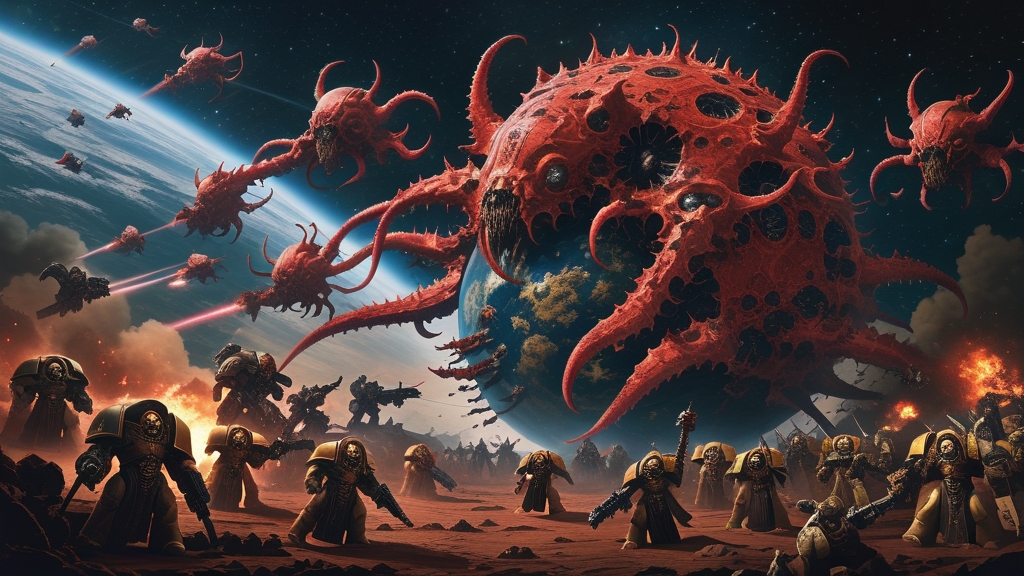
The Tyranids represent the greatest existential threat to the galaxy, followed by Chaos, the Necrons, and the Orks. While Chaos is the most immediate and corrupting danger, the Tyranids have the potential to consume all biomass in the Milky Way, ending all life permanently.
Warhammer 40k’s galaxy is besieged by threats on every front, but not all threats are equal. Some endanger individual worlds or sectors, while others threaten the very existence of life itself. This ranking examines each major threat by its potential to end civilisation as we know it, drawing on lore from across the setting’s history.
Why Are the Tyranids the Biggest Threat?
The Tyranids are ranked as the greatest existential threat because they represent something no other enemy does: total annihilation without any possibility of coexistence, negotiation, or resistance. The Tyranid Hive Fleets are extragalactic predators — they come from beyond the Milky Way, drawn by the Astronomican’s psychic light, and their purpose is simple: consume all biomass in the galaxy and move on.
What makes the Tyranids uniquely terrifying is their scale. The Hive Fleets that have so far reached the Milky Way — Behemoth, Kraken, Leviathan, and others — are believed to be merely the vanguard of a far larger force. The main body of the Tyranid species is still approaching from intergalactic space, and its true size is unknown. Some estimates suggest the full Tyranid swarm dwarfs every other military force in the galaxy combined by orders of magnitude.
The Tyranids’ adaptive biology means they grow stronger from every engagement. When they consume a world, they absorb its biomass and use it to create new organisms optimised to counter whatever defences they encountered. They have adapted to fight Space Marines, Eldar, Orks, Necrons, and Chaos — each encounter making them more effective against that particular enemy. Over time, this adaptive capability makes the Tyranids increasingly difficult to resist.
Most critically, the Tyranids cannot be reasoned with, bribed, deceived, or deterred. They have no territory to defend, no leaders who can be assassinated, no supply lines to cut. They are a biological force of nature, as impersonal and unstoppable as entropy itself. The only defence against them is to kill them all — and every one you kill provides biomass for the next wave.
How Dangerous Is Chaos Compared to the Tyranids?
Chaos — the collective term for the four Dark Gods (Khorne, Tzeentch, Nurgle, and Slaanesh) and their daemonic legions — is the most immediate and pervasive threat in Warhammer 40k, even if it is not the most existentially dangerous in the long term. Chaos threatens not just physical destruction but spiritual corruption, capable of turning the Imperium’s greatest defenders into its worst enemies.
The Horus Heresy demonstrated the devastating potential of Chaos corruption. Half the Space Marine Legions, including the Warmaster himself, were turned against the Emperor. The resulting civil war nearly destroyed humanity and left the Emperor a broken shell on the Golden Throne. No other force has come as close to annihilating the Imperium from within.
Chaos has several advantages over other threats. It operates across dimensional boundaries — the Warp touches every point in the material universe, meaning daemons can potentially manifest anywhere. It corrupts from within, turning loyal servants into traitors without any external invasion. The Great Rift, which tore the galaxy in half, has massively increased Chaos’s ability to project power into realspace, with daemonic incursions becoming more frequent and more powerful.
However, Chaos also has fundamental limitations. The Chaos Gods are not unified — they fight each other as viciously as they fight the material universe. Their attention is mercurial, and their invasions tend to be episodic rather than sustained. Chaos cannot permanently occupy or consume territory the way the Tyranids can. And perhaps most importantly, Chaos needs sentient beings to exist — without emotions to feed on, the Chaos Gods would weaken and potentially fade. This means Chaos has a paradoxical interest in keeping the galaxy populated, not in destroying it entirely.
What Makes the Necrons So Dangerous?
The Necrons represent a threat that is unique in its nature: a galaxy-spanning civilisation of functionally immortal machines that ruled the stars sixty million years ago and is now waking up. Their technology is so advanced that it borders on magic — capable of rewriting the laws of physics, extinguishing stars, and manipulating time itself.
At their height during the War in Heaven, the Necrons and their C’tan star-god masters conquered the galaxy. Their Tomb Worlds — hidden beneath the surfaces of planets across the Milky Way — number in the hundreds of millions, each containing legions of dormant Necron warriors waiting to be reawakened. If every Tomb World woke simultaneously, the resulting force would overwhelm every other military in the galaxy.
Necron technology is millennia ahead of anything the Imperium possesses. Their gauss weapons strip targets apart at the molecular level. Their bodies can self-repair from almost any damage. Their Monoliths are mobile fortresses that can teleport across space. The Necron Pylons can suppress the Warp itself, potentially sealing the barrier between realspace and the immaterium permanently — a capability that makes them uniquely positioned to counter Chaos but also threatens every psyker in the galaxy, including the Emperor himself.
The Necrons are ranked below Chaos and the Tyranids primarily because of their fragmented state. The various Necron Dynasties do not act in concert — they fight each other, pursue individual agendas, and are led by Overlords whose sanity varies wildly after sixty million years of dormancy. A united Necron empire would be virtually unstoppable, but unity is precisely what they lack.
How Big a Threat Are the Orks Really?
The Orks are often underestimated because of their comical culture and crude technology, but they represent a galaxy-spanning threat of enormous proportions. They are the most numerous intelligent species in the galaxy, found on more worlds than any other. Their fungal reproduction makes them nearly impossible to eradicate permanently. And their growth-through-fighting mechanism means that any prolonged conflict with Orks risks producing a Warlord of apocalyptic power.
The Beast Arises series demonstrated what happens when an Ork leader of sufficient power unites a significant portion of the species. The Beast’s WAAAGH! attacked Terra itself, breaching the Imperial Palace’s defences and nearly destroying the Imperium. Ghazghkull Mag Uruk Thraka, the current greatest Ork Warlord, is building towards a WAAAGH! of similar or even greater scale.
The Orks’ true danger lies in their theoretical maximum power. If the entire Orkoid species were ever unified under a single leader, their combined WAAAGH! field would be powerful enough to reshape reality on a galactic scale. Imperial xenobiologists have theorised that fully unified Orks might achieve a level of collective psychic power exceeding even the Emperor’s. This theoretical scenario is so catastrophic that some Imperial strategists deliberately work to keep the Orks divided, viewing Ork-on-Ork conflict as essential to galactic stability.
What About the Dark Eldar and Drukhari?
The Drukhari (Dark Eldar) of Commorragh are not a galaxy-ending threat but a persistent, horrifying danger to individual worlds and populations. They raid realspace from their pocket dimension in the Webway, abducting millions for torture and enslavement. Their technology, particularly in the fields of biology and pain-infliction, is more advanced than anything the Imperium possesses.
Commorragh itself is a city of such scale that it may contain a population larger than the Imperium. The Drukhari’s control of portions of the Webway gives them strategic mobility that exceeds even Eldar Craftworld capabilities. And their absolute dependence on inflicting suffering — they must torture others to prevent their own souls from being consumed by Slaanesh — means they will never stop raiding, never negotiate peace, and never show mercy.
However, the Drukhari have no interest in conquest or extinction. They need other species alive and suffering to sustain themselves. This makes them a permanent threat but not an existential one — they will never try to destroy the galaxy, because they need it to exist.
Is the Tau Empire a Real Threat?
The Tau Empire is the youngest major civilisation in the galaxy, and while it is expanding rapidly, it is not yet a genuine galactic-level threat. The Tau control a tiny fraction of the galaxy compared to the Imperium, and their military forces, while technologically advanced, are minuscule by comparison.
What makes the Tau concerning to the Imperium is not their current power but their trajectory. The Tau expand through a combination of military conquest and diplomatic absorption, offering neighbouring species a place in their “Greater Good” philosophy. This approach has proven effective at winning over disaffected Imperial populations, minor xenos species, and even some human worlds. If the Tau continue to expand at their current rate, they could eventually become a serious regional power.
The Tau’s primary limitations are their lack of Warp capability (they use slower-than-light or limited FTL travel methods), their small population, and their naivety about the true nature of the galaxy’s threats. The Tau have had limited exposure to Chaos, Tyranids, and Necrons, and their optimistic philosophy has not yet been tested against the full horror of what the galaxy contains.
How Do These Threats Interact With Each Other?
One of the most fascinating aspects of Warhammer 40k’s threat landscape is how the various dangers interact and sometimes counterbalance each other. The Necrons’ Warp-suppressing technology is potentially the most effective counter to Chaos in the galaxy. The Tyranids’ Shadow in the Warp disrupts Chaos as well, since daemons cannot exist in areas where the Hive Mind’s psychic presence dominates. Orks fight everyone indiscriminately, which often serves to slow or divert other threats.
The Imperium has occasionally exploited these interactions, deliberately redirecting one threat against another. Inquisitors have manipulated Ork WAAAGH!s into Tyranid-infested space, hoping the two forces will weaken each other. The Eldar have worked to awaken specific Necron Tomb Worlds in the path of Chaos incursions. These desperate gambits reflect the Imperium’s strategic reality — facing too many threats simultaneously and lacking the resources to fight them all directly.
Could Any Single Threat Actually Destroy the Galaxy?
Only the Tyranids have the demonstrated capability and apparent intent to consume all life in the Milky Way. Chaos could conceivably corrupt the entire galaxy, but this would ultimately be self-defeating — without sentient beings to generate emotion, the Chaos Gods would starve. The Necrons could potentially sterilise the galaxy using their most destructive weapons, but most Necron Overlords have more nuanced goals than simple destruction. The Orks, if fully unified, might achieve galaxy-spanning dominance, but they would not intentionally destroy all life — they need enemies to fight.
The true danger may not be any single threat but the combined weight of all of them pressing simultaneously against a weakening Imperium. The Great Rift has divided humanity’s empire. The Tyranids are closing in from multiple directions. Chaos is stronger than it has been since the Heresy. Necron Tomb Worlds are awakening in ever-greater numbers. And the Orks are building toward a WAAAGH! of unprecedented scale.
In the grim darkness of the far future, it may not matter which threat is the greatest. What matters is that they are all growing stronger while the Imperium grows weaker — and the question is not whether humanity will face its greatest test, but when.
Related Content
- Warhammer 40k Explained Simply — Get a simple overview of the 40k universe
- The Horus Heresy Explained — Learn about the greatest internal threat the Imperium faced
- Tyranids — Explore the Tyranid faction — a top galactic threat
- The Great Rift — Understand how Chaos tore the galaxy apart