
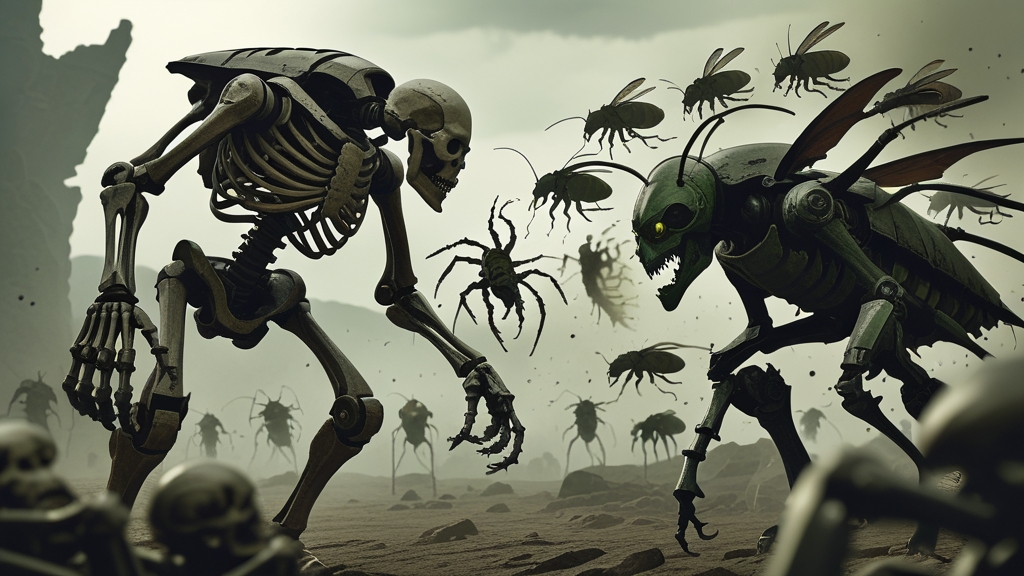
Part of our Necrons hub: every Necrons guide, lore page and painting tutorial in one place.
In the lore, this is the Silent King’s greatest fear — the Tyranids consume biomass while Necrons have none to consume, but the swarm’s sheer numbers threaten to overwhelm even living metal. The Silent King Szarekh returned from his self-imposed exile specifically because he recognised the Tyranid threat as an existential danger to everything in the galaxy, including his own species. On the tabletop, both are top-tier armies with very different playstyles — Necrons grind with resurrection protocols while Tyranids overwhelm with sheer volume and adaptive biology.
Why Does the Silent King Fear the Tyranids?
The Silent King spent millennia wandering the intergalactic void after the War in Heaven and the great sleep of the Necrons. During this exile, he encountered the Tyranid hive fleets approaching the galaxy and immediately recognised them as the single greatest threat to all life — and all unlife.
The Tyranids are unique among the galaxy’s threats because they don’t want territory, resources, or power in any conventional sense. They want biomass. Everything organic is food. This means most of the galaxy’s factions are existentially threatened — but the Necrons face a different problem entirely.
Necrons are living metal. They have no biomass to consume. In theory, the Tyranids should simply ignore them. But the reality is more complex. Tyranid hive fleets strip worlds bare — not just of life but of atmosphere, water, and minerals. A galaxy consumed by Tyranids would be a galaxy of dead rocks, and even the Necrons need worlds with infrastructure to maintain their tomb complexes and dynasties.
More importantly, the Silent King’s ultimate goal is biotransference reversal — returning Necron consciousness to organic bodies. If the Tyranids consume all organic life, that goal becomes permanently impossible. The Tyranids don’t just threaten Necron survival; they threaten Necron redemption.
This is why Szarekh has made unprecedented overtures to other factions, including temporary truces with the Imperium. The enemy of everything is, temporarily, everyone’s enemy.
How Do Necrons and Tyranids Match Up in the Lore?
The lore presents this matchup as uniquely problematic for both sides, which is what makes it so compelling.
Necron advantages: Necrons possess technology so advanced it appears as magic — gauss weapons that strip matter at the atomic level, phase technology that lets them teleport and become intangible, and self-repair protocols that can reassemble a destroyed Necron warrior in seconds. Their C’tan Shards can manipulate reality itself, and their Crypteks wield techno-sorcery that defies comprehension.
Critically, Necrons cannot be consumed. A Tyranid that kills a Necron warrior gains nothing — no biomass, no genetic material, no sustenance. The body phases out and teleports back to the tomb world for repair. This makes fighting Necrons a net energy loss for the swarm, which violates the Tyranids’ fundamental biological imperative of efficiency.
Tyranid advantages: The swarm has numbers that even the Necrons struggle to match. A major hive fleet can field billions of organisms across a system, and every creature that falls is recycled into new bioforms. The Hive Mind adapts constantly — if gauss weapons prove devastating, the next wave will have organisms specifically evolved to resist atomic disassembly.
The Tyranids also have the Shadow in the Warp, which disrupts psychic communication. While Necrons aren’t psykers, some of their technology has interactions with the Warp that could be affected. And the sheer physical mass of a Tyranid invasion can simply bury Necron forces under bodies — it doesn’t matter that each warrior phases out if the planet is stripped bare before they can reassemble.
In established lore, direct conflicts between Necrons and Tyranids have gone both ways. The Sautekh Dynasty under Imotekh the Stormlord has successfully repelled Tyranid incursions using overwhelming firepower and strategic brilliance. But other dynasties, particularly those still in the process of awakening, have been overwhelmed before they could bring their full power to bear.
What Happens When They Fight on the Tabletop?
On the tabletop, Necrons and Tyranids represent two of the most mechanically distinct factions in the game, and their matchup is fascinating.
Necrons play the attrition game. Their Reanimation Protocols army rule means destroyed models have a chance to stand back up at the start of each Command Phase. This makes Necron units deceptively durable — what looks like a destroyed squad can regenerate back to fighting strength if the opponent doesn’t finish the job. Their shooting is precise and efficient, with gauss weapons offering reliable anti-armour capability across the entire range.
Key Necron strengths in this matchup include their ability to outshoot Tyranids at range, their durability through reanimation, and powerful character support from Overlords and Crypteks. A well-positioned Necron gun-line with Reanimation Protocols active is extremely difficult for melee-focused Tyranids to crack.
Tyranids overwhelm through volume and adaptation. Their army rules typically reward aggressive play, and their model range includes everything from swarms of cheap Termagants to monstrous Carnifexes and the terrifying Hierophant bio-titan. Tyranids want to cross the board quickly, tie up shooting units in melee, and use their monsters to crack tough targets.
Against Necrons specifically, Tyranids need to deal enough damage in a single turn to prevent effective reanimation. Killing three out of ten Warriors is pointless if two stand back up. Tyranids need to wipe entire units or focus fire so thoroughly that reanimation rolls are irrelevant. This often means committing overwhelming force to one flank rather than spreading damage across the board.
The matchup typically favours whichever player better controls the mid-board objectives. Necrons want to hold ground and grind; Tyranids want to flood and overwhelm. If the Tyranid player reaches melee intact, they have the advantage. If the Necron player keeps them at arm’s length with overlapping fields of fire, the Necrons grind out the win.
Could the Necrons Actually Stop the Tyranids?
This is one of the great unanswered questions in 40k lore. The Silent King believes it’s possible, but only through galaxy-wide coordination — which is why he’s attempting to unite the fractious Necron dynasties and even cooperate with other species.
The Necrons have several unique advantages in this fight. Their Dolmen Gates allow faster-than-light travel without the Warp, meaning the Shadow in the Warp doesn’t affect their strategic mobility. Their gauss technology is brutally effective against bio-armour. And their complete lack of biomass makes them the only faction that can fight Tyranids without feeding them.
However, the Necrons are still awakening. Millions of tomb worlds remain dormant, and those that have awakened are often at partial strength with malfunctioning systems and reduced populations. If the Tyranids hit before the Necrons reach full power, the ancient empire may fall before it fully rises.
The lore deliberately keeps this ambiguous. Games Workshop wants the tension of an unstoppable force meeting an immovable object. The Tyranids are the ultimate predator; the Necrons are the ultimate survivors. Neither can afford to lose, and the galaxy burns regardless of who wins.
Which Army Is More Fun to Play?
Both armies offer deeply satisfying gameplay, but they appeal to different player personalities.
Play Necrons if you enjoy:
- Grinding attrition — watching your opponent despair as models keep standing back up
- Reliable, consistent shooting that degrades the enemy steadily
- Elite, tough units that refuse to die
- Ancient Egyptian-inspired sci-fi aesthetics with glowing green energy
- A slower, more methodical playstyle focused on board control
Play Tyranids if you enjoy:
- Overwhelming your opponent with sheer numbers and aggression
- Adaptive strategies — changing your approach based on what you’re fighting
- A mix of expendable swarms and terrifying monsters
- The alien horror aesthetic — Tyranids are the Xenomorphs of 40k
- Aggressive, in-your-face gameplay that pressures from turn one
What Would a Galaxy Without Either Faction Look Like?
If the Tyranids consumed the Necrons, they would gain nothing — no biomass, no evolutionary advantage. But they would remove one of the few forces capable of matching them technologically. The remaining factions — the Imperium, Chaos, the Aeldari — would face an even more overwhelming threat without Necron firepower to share the burden.
If the Necrons destroyed the Tyranids, the Silent King would turn his attention back to his original goals — rebuilding the Necron empire and eventually pursuing biotransference reversal. Without the Tyranid threat, Necron unity would fracture as individual dynasties resumed their petty wars. The Imperium might find itself facing a resurgent Necron empire with no common enemy to justify even temporary truces.
Frequently Asked Questions
Can Tyranids eat Necrons?
No. Necrons are made of living metal (necrodermis) and contain no biomass. When a Necron is destroyed, its body phases out and teleports back to its tomb world for repair. Tyranids gain nothing from fighting Necrons, which makes the swarm’s continued aggression toward them a fascinating lore mystery — the Hive Mind may recognise Necrons as a strategic threat that must be eliminated regardless of nutritional value.
Has the Silent King fought the Tyranids directly?
Yes. Szarekh encountered the Tyranid hive fleets during his exile in the intergalactic void and fought them before returning to the galaxy. He has since directed multiple campaigns against Tyranid incursions, and his return to Necron space was primarily motivated by the need to prepare his species for this existential threat.
Which faction has more models to collect?
Both have extensive model ranges, but Tyranids arguably offer more variety in terms of visual diversity. The Tyranid range includes tiny Rippers, medium infantry like Warriors, and massive monsters like the Tyrannofex and Hierophant. Necrons have a more uniform aesthetic but offer unique constructs like the Monolith, Doom Scythe, and C’tan Shards that are visually stunning centrepieces.
Are Necrons or Tyranids better for beginners?
Necrons are generally considered more beginner-friendly. Their units are durable and forgiving — Reanimation Protocols give you a second chance when you make positioning mistakes. Tyranids require better understanding of when to sacrifice units and how to manage multiple threat vectors. That said, both armies have starter sets and Combat Patrol boxes that make getting into the hobby straightforward.
Do Necrons and Tyranids ever ally?
Never. These two factions are fundamentally incompatible. Necrons see Tyranids as the ultimate threat to their species’ future, and Tyranids see everything as either food or an obstacle. There is no diplomacy possible with the Hive Mind, and the Silent King would never consider cooperation with the Great Devourer.
Did the Necrons create the Tyranids?
No. The Tyranids come from outside the galaxy, and their true origin is unknown. The Necrons had nothing to do with creating them. The Silent King only learned the scale of the threat after seeing the hive fleets during his exile beyond the galaxy’s edge, which is what brought him back.
Does the Shadow in the Warp affect Necrons?
Barely. The Shadow in the Warp blocks psychic powers and Warp communication, and Necrons don’t rely on psykers or Warp travel. Their dolmen gates and other technology work outside the Warp, so the Shadow that cripples Imperial astropaths and Navigators does little to slow a Necron response.