
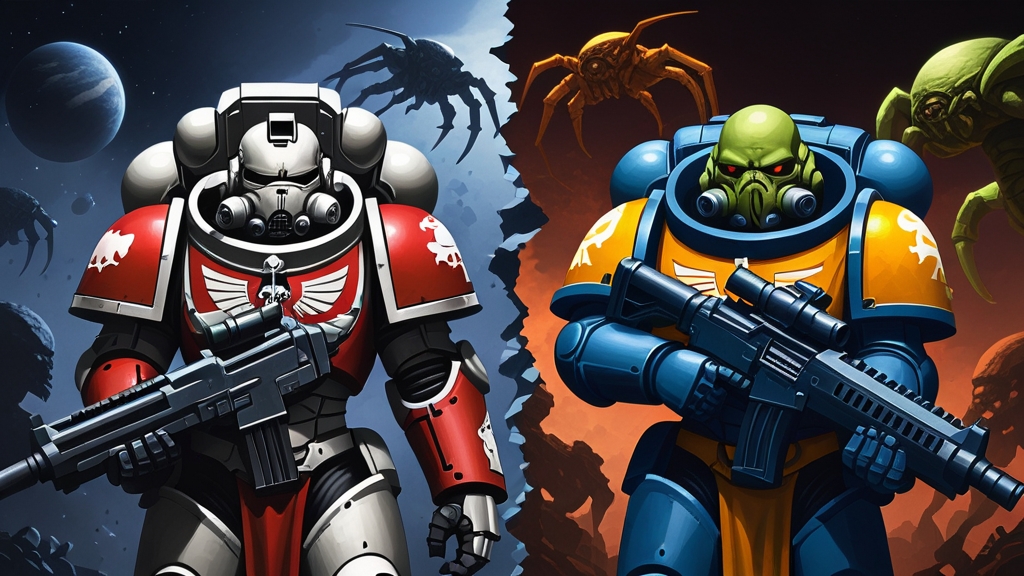
Warhammer 40k vs StarCraft — The Inspiration Debate
StarCraft was heavily inspired by Warhammer 40k. The Terran Marines, Zerg, and Protoss closely parallel Space Marines, Tyranids, and Eldar respectively. Blizzard originally intended to make a licensed Warhammer game before the deal fell through, and StarCraft emerged from the remnants of that project.
The relationship between Warhammer 40k and StarCraft is one of the most discussed topics in gaming history. Understanding the timeline of events, the specific parallels between factions, and how both franchises have evolved reveals a story of creative inspiration, commercial pragmatism, and two universes that have become excellent in their own right.
Did Blizzard Originally Plan a Warhammer Game?
The connection between Blizzard Entertainment and Games Workshop predates StarCraft and even Warcraft. In the early 1990s, Blizzard (then known as Silicon & Synapse) was reportedly in discussions with Games Workshop about creating a licensed Warhammer video game. The details of these negotiations are not fully public, but the widely accepted account is that the deal fell through due to licensing disagreements — Games Workshop wanted more control over the product than Blizzard was willing to concede.
When the deal collapsed, Blizzard proceeded to create Warcraft: Orcs & Humans (1994) — a real-time strategy game that bore unmistakable similarities to Warhammer Fantasy Battle. Orcs versus humans, the core aesthetic, and the general tone all echoed Games Workshop’s fantasy setting. However, Blizzard developed their own lore, characters, and world-building that quickly diverged from Warhammer Fantasy into something distinct.
The same pattern repeated with StarCraft. When Blizzard moved to develop a science fiction RTS, the Warhammer 40k influence was even more apparent than the Warhammer Fantasy influence had been in Warcraft. The three-faction structure, the aesthetic choices, and the fundamental concepts all showed clear inspiration from Games Workshop’s grimdark future.
How Do the Terrans Compare to the Imperium?
The Terran Confederacy (and later the Terran Dominion) in StarCraft parallels the Imperium of Man in several key ways. Both are human civilisations in a hostile galaxy. Both are militaristic, authoritarian, and willing to sacrifice individual lives for collective survival. Both use enhanced soldiers in powered armour as elite military forces.
The Terran Marine is the most obvious parallel to the Space Marine. Both wear powered armour, carry oversized weapons, and serve as the backbone of humanity’s military. However, the parallels diverge significantly in execution. Terran Marines are often conscripted criminals who are “resocialised” (essentially brainwashed) rather than genetically engineered volunteers. They are expendable frontline troops, not the elite warriors that Space Marines represent. In terms of 40k equivalents, Terran Marines are actually closer to Imperial Guard Stormtroopers than to Astartes.
The Ghost programme in StarCraft — psychic operatives in stealth suits — has clear parallels to various 40k assassin and psyker units. Ghosts combine the stealth capabilities of Vindicare Assassins with the psychic abilities of Sanctioned Psykers, wrapped in a concept that feels distinctly 40k-inspired. The ethical horror of the Ghost programme — children taken from their families and turned into weapons — echoes the Space Marine and Culexus Assassin recruitment processes.
The Terran setting is also significantly smaller in scale than the Imperium. Where the Imperium spans a million worlds across an entire galaxy, the Terran civilisation in StarCraft occupies a relatively small region of space. This difference in scale reflects the different narrative needs of the two franchises — StarCraft tells more personal, character-driven stories that benefit from a smaller setting, while 40k’s vast scale serves its themes of insignificance and institutional decay.
How Do the Zerg Compare to the Tyranids?
The Zerg are the most frequently cited parallel between StarCraft and Warhammer 40k, and for good reason. Both are alien hive-mind organisms that consume other species, adapt their biology through assimilation, and represent an existential threat to all other life. The similarities are extensive and specific.
Both the Zerg and the Tyranids operate through a collective consciousness — the Zerg Overmind (later Kerrigan) and the Tyranid Hive Mind respectively. Both consume biomass to fuel their growth. Both adapt by incorporating genetic material from the species they consume. Both produce a vast variety of specialised biological organisms for different roles. Both are depicted as an overwhelming tide of alien life that threatens to consume everything in its path.
However, the two factions have diverged significantly over time. The Zerg developed individual characters — particularly Sarah Kerrigan, the Queen of Blades, who became one of StarCraft’s most compelling protagonists. The Tyranids have no such characters; they remain a faceless, impersonal force of nature. This reflects the different narrative approaches — StarCraft uses the Zerg as a vehicle for character stories, while 40k uses the Tyranids as an embodiment of existential dread.
The Zerg’s Creep — the organic matter they spread across terrain — parallels the Tyranids’ Capillary Towers and bio-structures that transform conquered worlds. Zerg Overlords parallel Tyranid synapse creatures. Zerglings parallel Hormagaunts. Hydralisks parallel Tyranid Warriors. Mutalisks parallel Gargoyles. The faction-level parallels are extensive enough that they clearly indicate shared inspiration, even as both franchises have developed their organisms in unique directions.
How Do the Protoss Compare to the Eldar?
The Protoss parallel the Eldar in several fundamental ways: both are ancient, psychically gifted, technologically advanced civilisations that are in decline. Both view themselves as superior to other species. Both have a tragic history involving a catastrophic fall from grace. Both use elegant, advanced technology that contrasts sharply with the brute-force approach of the human factions.
The Protoss’s Psionic abilities mirror the Eldar’s psychic powers. The Khala — the psychic network connecting all Protoss — has similarities to the Eldar’s Path system and their connection to the Warp. The Dark Templar, who severed their connection to the Khala, parallel the Dark Eldar (Drukhari), who separated from the Craftworld Eldar and developed their own culture.
Protoss technology — Pylons, Warp Gates, Shield Generators — echoes the Eldar’s Webway technology, Wraithbone construction, and energy-based warfare. Both factions favour precision and quality over the mass-production approach of their human counterparts. Both field relatively small armies of individually powerful units rather than hordes of expendable troops.
The Protoss homeworld of Aiur, which was consumed by the Zerg, parallels the Eldar’s lost homeworlds, which were consumed by the birth of Slaanesh. Both factions are defined by this loss and by their ongoing struggle to survive as a diminished people in a hostile galaxy. However, the Protoss retain more military power relative to other factions than the Eldar do, and their civilisation is portrayed as having a more viable future.
Where Do the Two Franchises Diverge?
Despite the clear parallels, StarCraft and Warhammer 40k have evolved into distinctly different properties with fundamentally different tones, themes, and narrative approaches.
Tone: Warhammer 40k is relentlessly bleak — a universe where hope is a luxury and survival is the best anyone can aspire to. StarCraft, while dark, maintains the possibility of heroism, redemption, and positive change. Characters in StarCraft can make choices that genuinely improve the galaxy. Characters in 40k are typically choosing between degrees of catastrophe.
Scale: Warhammer 40k operates on a vastly larger scale than StarCraft. The Imperium’s million worlds, the Tyranid threat from outside the galaxy, and the cosmic horror of the Chaos Gods make 40k’s conflicts feel apocalyptic in a way that StarCraft’s more contained setting does not attempt.
Characters: StarCraft is fundamentally a character-driven franchise. Jim Raynor, Sarah Kerrigan, Artanis, and other named characters drive the narrative through personal choices and emotional arcs. Warhammer 40k has named characters, but the setting is not driven by individuals — it is driven by factions, institutions, and cosmic forces that dwarf any single person.
Gameplay origin: StarCraft was designed as a real-time strategy video game, with its lore built to serve gameplay needs. Warhammer 40k originated as a tabletop miniatures game, with its lore developed to sell physical products and provide context for player-driven narratives. These different origins have shaped every aspect of both franchises’ development.
What Did Blizzard Bring That Was Original?
It would be unfair to characterise StarCraft as merely a Warhammer 40k copy. While the inspiration is clear, Blizzard brought significant original elements to the franchise that made it a distinct and excellent property in its own right.
StarCraft’s gameplay — tightly balanced three-faction RTS design — set the standard for competitive strategy gaming and has no direct equivalent in Games Workshop’s products. The game’s esports legacy, particularly in South Korea, created a competitive gaming culture that influenced the entire industry.
Blizzard’s character development far exceeded anything Games Workshop produced in the equivalent period. Kerrigan’s arc from human ghost to Zerg queen to xel’naga entity is one of the most compelling character journeys in gaming history. Jim Raynor’s everyman heroism provides a relatable perspective that 40k rarely offers.
The art direction, while initially similar to 40k’s, developed its own distinctive style. StarCraft’s visual identity — bulkier, more colourful, more exaggerated than 40k’s Gothic aesthetic — became iconic in its own right and influenced countless subsequent science fiction games.
How Does Games Workshop View the Relationship?
Games Workshop has never publicly pursued legal action against Blizzard over StarCraft, despite the visible parallels. This may be because the similarities, while obvious to fans, are not specific enough to constitute copyright infringement — you cannot copyright a concept like “space bugs” or “psychic space elves.” It may also reflect a pragmatic calculation that StarCraft introduces millions of players to concepts that might lead them to discover Warhammer 40k.
Games Workshop has, however, been more aggressive in protecting its intellectual property in other contexts, including legal actions against smaller companies that used terms like “Space Marine” in their products. The apparent tolerance of StarCraft’s similarities suggests either a legal judgment that the case would be difficult to win or a strategic decision that Blizzard is too large and the similarities too general to make litigation worthwhile.
Some fans have speculated that there is an informal understanding between the two companies — a recognition that both benefit from the other’s existence. StarCraft players who discover 40k find a deeper, more expansive universe to explore. Warhammer fans who play StarCraft find a polished gaming experience that their franchise has often struggled to match in the video game space.
What Is Each Franchise’s Legacy?
Both Warhammer 40k and StarCraft have achieved extraordinary cultural impact, albeit in different domains. Warhammer 40k has defined the grimdark genre, influenced countless novels, games, and films, and built a hobby community spanning millions of collectors, painters, and players worldwide. Its miniatures business generates hundreds of millions in annual revenue, and its intellectual property is being adapted for major film and television productions.
StarCraft defined competitive gaming, particularly in South Korea, where professional StarCraft matches drew television audiences of millions. It established the real-time strategy genre as a major force in gaming and proved that science fiction strategy games could achieve mainstream commercial success. StarCraft II continued this legacy with one of the most polished RTS experiences ever created.
Together, the two franchises have enriched science fiction gaming immeasurably. The influence flows in both directions — Warhammer 40k inspired StarCraft, but StarCraft’s commercial success and gameplay innovations have in turn influenced how Games Workshop approaches video game adaptations of its properties. The relationship between the two is competitive but ultimately complementary, and fans of either franchise owe something to the other.
Does It Matter Who Inspired Who?
The inspiration debate, while historically interesting, is ultimately less important than what each franchise has achieved on its own merits. StarCraft drew from Warhammer 40k in the same way that Warhammer 40k drew from Dune, Starship Troopers, Alien, and dozens of other science fiction works. Creative inspiration is not theft — it is how genres evolve and improve.
What matters is that both franchises have created rich, compelling universes that have entertained millions of people for decades. Warhammer 40k’s grimdark depth and hobbyist community are unmatched. StarCraft’s gameplay polish and competitive legacy are unmatched. Both have earned their place in the pantheon of great science fiction franchises, and both will continue to influence the genre for decades to come.
In the end, the best response to “Did StarCraft copy Warhammer 40k?” is “Who cares? Both are excellent. Play both.”
Related Content
- Warhammer 40k Explained Simply — Get the basics of the Warhammer 40k universe
- Warhammer 40k vs Star Wars — See how Warhammer compares to Star Wars
- What Is Grimdark? — Understand the grimdark tone that defines Warhammer
- Best Warhammer Video Games — Play the best Warhammer video games