
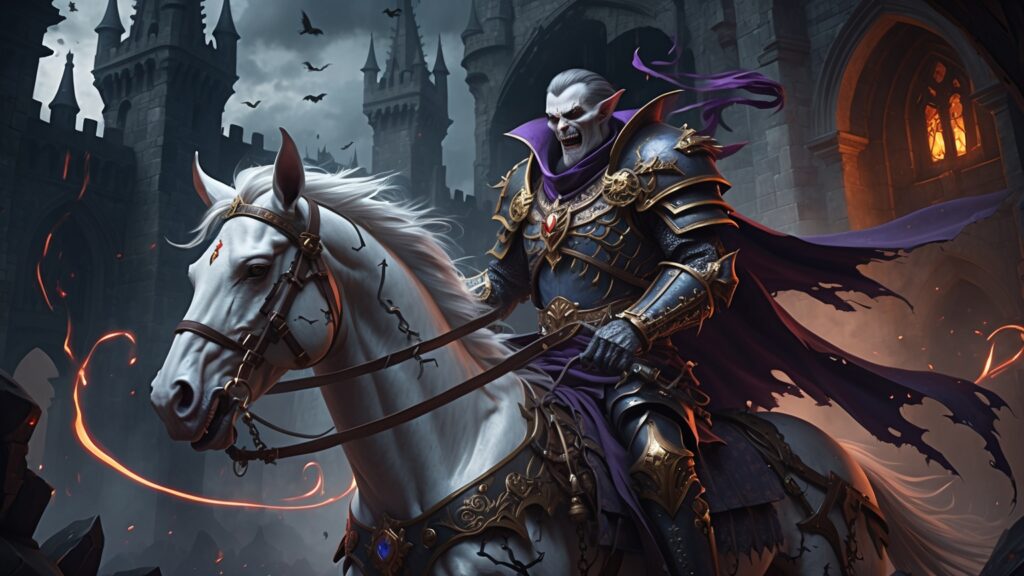
Mannfred von Carstein is one of Warhammer’s most notorious villains — a vampire whose betrayals have shaped the fate of entire worlds. He is the Mortarch of Night who literally ended the World-That-Was by stabbing Ghal Maraz’s bearer at the critical moment, dooming the old world to destruction. In Age of Sigmar, he serves Nagash as one of the Soulblight Gravelords‘ most powerful leaders — always scheming, always ambitious, and never to be trusted by anyone, including his own master.
What defines Mannfred is not his strength — though he is formidable — but his treachery. He is a vampire who will ally with anyone, betray anyone, and sacrifice anyone to advance his own position. He has betrayed Nagash, betrayed Sigmar, betrayed his fellow vampires, and betrayed allies on the battlefield when their deaths served his interests. His treachery is not impulsive — it is calculated, patient, and devastatingly effective. Mannfred always has a plan, and the plan always serves Mannfred.
Who Was Mannfred in the World-That-Was?
In the original Warhammer Fantasy setting, Mannfred von Carstein was the last and most cunning of the Von Carstein vampire counts — the dynasty that terrorised the Empire from their stronghold in Sylvania. The Von Carstein line was founded by Vlad von Carstein, who was the first vampire to openly wage war against the Empire with vast undead armies. After Vlad’s destruction, his successors — including the insane Konrad von Carstein — continued the Von Carstein Wars until Mannfred emerged as the dynasty’s final leader.
Mannfred was different from his predecessors. Where Vlad had been charismatic and Konrad had been savage, Mannfred was calculating. He studied necromancy with a scholarly dedication that made him one of the most powerful practitioners of death magic in the world. He fought the Empire not through frontal assault but through strategic manipulation, raising armies at carefully chosen moments and withdrawing when the odds turned against him. He survived defeats that destroyed other vampires because he always had an escape plan.
Mannfred’s defining moment came during the End Times — the apocalyptic campaign that destroyed the Warhammer Fantasy world. In the final battle, when the forces of Order were making their last stand against Chaos, Mannfred betrayed the alliance by attacking Balthasar Gelt (who was channelling the Wind of Death to help seal the Chaos rift). This single act of treachery — motivated by Mannfred’s refusal to accept a world he could not rule — ensured that the ritual to save the world failed. The World-That-Was was destroyed, and Mannfred von Carstein bore more responsibility for its destruction than almost any other individual.
How Did Mannfred Survive into Age of Sigmar?
Mannfred’s soul survived the destruction of the World-That-Was because Nagash — the God of Death — claimed it. Nagash rebuilt Mannfred as one of his Mortarchs, the Mortarch of Night, granting him power and authority within the new Mortal Realms. This was not a reward — it was a leash. Nagash trusted Mannfred no more than anyone else did, but he recognised that Mannfred’s intelligence, magical power, and ruthlessness made him a useful instrument.
In the Age of Sigmar, Mannfred occupies a position of significant power within Nagash’s hierarchy, but he chafes under the God of Death’s authority. Mannfred’s fundamental nature is that of a schemer who serves no one willingly — he bows to Nagash because Nagash is more powerful, not because he is loyal. If Mannfred ever saw an opportunity to overthrow Nagash and seize power for himself, he would take it without hesitation. Nagash knows this, and the tension between master and servant is a constant undercurrent in their relationship.
What Makes Mannfred So Treacherous?
Mannfred’s treachery is not a personality flaw — it is a strategy. He views loyalty as a weakness exploitable in others and a liability in himself. By remaining unpredictable and self-serving, Mannfred ensures that no one can anticipate his actions or take his support for granted. This makes him a difficult ally but an even more difficult enemy, because fighting Mannfred means fighting someone who will change sides the moment it benefits him.
His betrayals follow a pattern. Mannfred allies himself with the strongest available faction, contributes just enough to remain valuable, and positions himself to benefit regardless of the outcome. If his allies win, he claims credit and rewards. If his allies lose, he switches sides before the defeat becomes total. This approach has kept him alive and powerful for thousands of years across two separate settings — a track record that argues for the effectiveness of treachery as a survival strategy, even if it makes him universally despised.
The community’s reaction to Mannfred is interesting — he is one of the most hated characters in Warhammer lore, not because he is boring or badly written, but because his treachery is so effective and so damaging. Fans who were devastated by the destruction of the World-That-Was often place the blame squarely on Mannfred’s shoulders, and the intensity of that reaction is a testament to how well the character works as a villain.
What Has Mannfred Done in Age of Sigmar?
In Age of Sigmar, Mannfred has been involved in several major narrative events. During the Age of Myth, he served as one of Nagash’s primary agents in the Mortal Realms, conquering territory in Shyish and establishing undead dominions. When the Age of Chaos began and Nagash retreated to consolidate his power, Mannfred continued to wage war — sometimes on Nagash’s behalf, sometimes on his own.
During the Soul Wars — triggered by Nagash’s Necroquake, which released a tidal wave of death magic across the Mortal Realms — Mannfred led Soulblight forces against both the Stormcast Eternals and other Death factions. His campaigns during this period were characterised by the same opportunistic treachery that defines his character — allying with Nighthaunt forces when convenient, abandoning them when the situation changed, and always positioning himself to benefit from the chaos (literal and figurative) that the Necroquake created.
Mannfred’s rivalry with Neferata — the other major vampire Mortarch — is a constant source of narrative tension. The two despise each other, and their mutual hostility has occasionally disrupted Nagash’s plans. Mannfred views Neferata as a schemer who hides behind manipulation because she lacks the courage for direct action. Neferata views Mannfred as a dangerous fool whose treachery is so predictable that it is barely worth worrying about. Their dynamic adds depth to the Soulblight Gravelords faction, ensuring that the forces of Death are not monolithically united but riven by internal politics.
What Is Mannfred Like on the Tabletop?
On the tabletop, Mannfred is a powerful combat character for the Soulblight Gravelords. He rides his Dread Abyssal — Ashigaroth — into battle, combining strong melee attacks with potent death magic. His rules typically reflect his dual nature as both a fighter and a sorcerer, with access to necromantic spells that can raise additional undead units, debuff enemies, and deal direct damage.
Mannfred’s model is one of the signature pieces of the Soulblight Gravelords range — a dramatic sculpt showing him mounted on the massive Dread Abyssal, sword raised, armour ornate and menacing. The model serves as both a powerful gaming piece and a centrepiece display model, and it is a rewarding (if challenging) painting project that showcases vampiric Gothic horror aesthetics.
On the tabletop, Mannfred rewards aggressive play. Unlike Katakros (who commands from behind the lines) or Neferata (who debuffs and manipulates), Mannfred is designed to get into combat and use his combination of magical and martial abilities to dominate the fight. He is at his best when he can engage enemy heroes and monsters in melee while supporting nearby friendly units with his magical abilities.
Frequently Asked Questions
Did Mannfred really destroy the Old World?
Yes. While many forces contributed to the End Times, Mannfred’s betrayal at the crucial moment — attacking Balthasar Gelt during the final ritual — directly caused the ritual’s failure and the world’s destruction. Other factors were involved, but Mannfred’s treachery was the proximate cause of the World-That-Was’s doom.
Is Mannfred stronger than Neferata?
In raw magical and combat power, they are roughly comparable. Mannfred is arguably a better fighter, while Neferata is a more skilled manipulator. In a direct confrontation, the outcome would depend on circumstances — Mannfred would have the advantage in a straight fight, but Neferata would ensure the fight was never straight.
Will Mannfred betray Nagash?
Almost certainly, if given the opportunity. Mannfred’s nature compels him to scheme against any authority he serves, and his loyalty to Nagash is purely pragmatic. The question is not whether Mannfred will betray Nagash but whether he will ever find an opportunity to do so successfully. So far, Nagash has been too powerful to challenge — but if Nagash is ever sufficiently weakened, Mannfred will strike.
Which Von Carstein is the most powerful?
In terms of raw power, Mannfred in his current Mortarch form is likely the most powerful Von Carstein to have existed. However, Vlad von Carstein — the dynasty’s founder — was arguably more dangerous in his prime, combining significant personal power with a charisma and strategic vision that Mannfred lacks. Vlad inspired loyalty; Mannfred inspires only fear and suspicion.
Related Content
- Chaos Knights Army Guide — explore the army behind the lore
- The Horus Heresy Explained — Complete Timeline & Guide — understand the pivotal Horus Heresy era
- Best Warhammer Books to Read — Fiction Guide — find great Warhammer novels to read
- Warhammer Etiquette Guide — Sportsmanship & Table Manners — explore more Warhammer content