
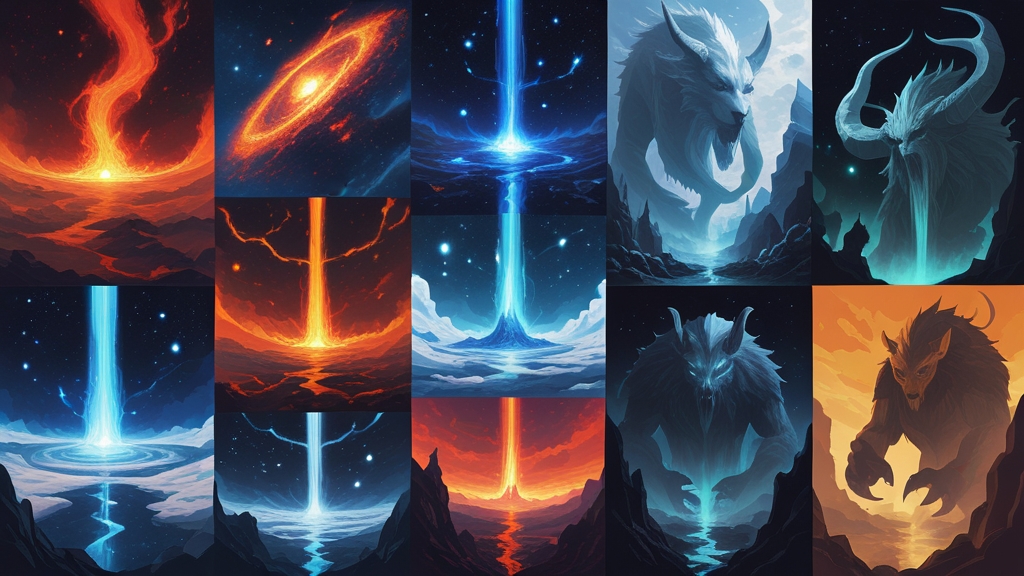
The Mortal Realms are eight interconnected planes of existence that form the setting of Warhammer Age of Sigmar. Each realm is a vast, seemingly infinite world shaped by one of the eight Winds of Magic — Azyr (Heavens), Ghyran (Life), Shyish (Death), Aqshy (Fire), Ghur (Beasts), Chamon (Metal), Hysh (Light), and Ulgu (Shadow). These are not planets in the conventional sense — they are entire realities, each with its own continents, civilisations, ecosystems, and laws of nature, all influenced by the magical wind that defines them. The Mortal Realms are connected to each other through Realmgates — magical portals that allow travel between the realms — and they orbit the cosmic void known as the Allpoints (or Eightpoints), a nexus where all eight realms converge.
The Mortal Realms are the successor setting to the World-That-Was (the original Warhammer Fantasy Battles world), created when the old world was destroyed during the End Times. They represent Games Workshop’s most ambitious worldbuilding project — a setting of literally infinite scale that can accommodate any story, any battle, and any civilisation imaginable. Understanding the Mortal Realms is essential for anyone interested in Age of Sigmar, whether as a tabletop player, a lore enthusiast, or a newcomer trying to make sense of this vast and fascinating setting.
How Were the Mortal Realms Created?
The Mortal Realms were born from the destruction of the World-That-Was. When the old Warhammer Fantasy world was destroyed during the End Times — consumed by Chaos in an apocalyptic cataclysm — the Winds of Magic that had permeated that world were scattered into the cosmic void. Each Wind, carrying with it the essence of its magical domain, coalesced into a new reality. The Wind of Azyr (Heavens magic) formed the Celestial Realm. The Wind of Ghyran (Life magic) formed the Realm of Life. And so on, for all eight Winds.
The souls of the old world’s gods survived the destruction, drawn to the realms that matched their divine nature. Sigmar, the warrior-god who had been the patron deity of the Empire, was found clinging to the core of the old world as it hurtled through the void — a metallic sphere called Mallus. The great celestial drake Dracothion found Sigmar and bore him to Azyr, where the God-King began to build a new civilisation. Other gods found their way to other realms: Nagash to Shyish, Alarielle to Ghyran, Gorkamorka to Ghur, Grungni to Chamon, Teclis and Tyrion to Hysh, and Malerion to Ulgu.
For a time — the era known as the Age of Myth — the gods cooperated, building civilisations across the Mortal Realms and creating a loose alliance called the Pantheon of Order. This was a golden age of exploration, construction, and relative peace. But it could not last. The Chaos Gods, who had destroyed the old world, eventually found the Mortal Realms and launched their invasion — the Age of Chaos — which would devastate realm after realm until Sigmar launched his counterattack with the Stormcast Eternals, beginning the Age of Sigmar.
What Is Each Realm Like?
Azyr — The Celestial Realm: The realm of Heavens magic, Azyr is a land of towering mountains, star-filled skies, and shining cities. It is the seat of Sigmar’s power and the most heavily defended of all the realms — during the Age of Chaos, Sigmar sealed the gates of Azyr to protect it from Chaos invasion, making it the last bastion of Order. The great city of Azyrheim is the capital of Sigmar’s empire, and it is from Azyr that the Stormcast Eternals are forged and launched into battle. Azyr’s landscape is defined by celestial phenomena — auroras, meteor showers, constellations that move with purpose, and mountains so high they pierce the firmament.
Ghyran — The Realm of Life: Ruled by Alarielle the Everqueen, Ghyran is a realm of explosive, overwhelming vitality. Forests grow in minutes, rivers change course daily, and the land itself pulses with living energy. This sounds idyllic, but Ghyran’s vitality is as dangerous as it is beautiful — plants grow with such aggression that they can consume settlements overnight, diseases mutate at terrifying speed, and the cycle of growth and decay operates at a pace that makes permanent civilisation extraordinarily difficult. During the Age of Chaos, Nurgle — the Chaos God of disease and decay — targeted Ghyran specifically, seeing the Realm of Life as the ultimate prize for the God of Death and Rebirth. Much of Ghyran was corrupted, its lush forests transformed into diseased swamps and plague gardens.
Shyish — The Realm of Death: The domain of Nagash, the God of Death, Shyish is the realm where souls go after death. It is not a single afterlife but a collection of thousands of different underworlds, each reflecting the beliefs and cultures of the civilisations whose dead populate them. A warrior culture might have an underworld of eternal battle; a peaceful agricultural society might have an afterlife of endless harvests. Nagash rules all of these underworlds, drawing power from the souls of the dead and commanding vast armies of undead. The realm’s landscape is appropriately morbid — bone deserts, seas of souls, cities of the dead, and the great inverted pyramid of Nagashizzar, Nagash’s fortress.
Aqshy — The Realm of Fire: A realm of passion, conflict, and flame, Aqshy is defined by extremes. Its landscapes range from volcanic wastelands to burning deserts to lands of crystallised fire. The civilisations that thrive in Aqshy tend to be aggressive, passionate, and warlike — the realm’s magical nature amplifies emotions and drives its inhabitants toward intensity in all things. Aqshy was one of the first realms to fall to Chaos during the Age of Chaos, as the Khorne — the Blood God — found its warlike nature particularly appealing.
Ghur — The Realm of Beasts: The wildest and most dangerous of the realms, Ghur is a world where the law of the jungle is literally the law of physics. Everything in Ghur is alive, hungry, and competing to survive. The continents themselves are alive — the landmasses of Ghur are titanic creatures (like the continent-beast Thondia) that slowly move, fight, and devour each other. Civilisation in Ghur is a constant struggle against an environment that is actively trying to eat you. Gorkamorka, the twin-natured god of destruction, calls Ghur home.
Chamon — The Realm of Metal: A realm of transmutation, alchemy, and material wealth, Chamon is a land where the very ground is made of metal — iron plains, gold mountains, silver rivers. The realm is defined by change and transformation; metals shift and transmute spontaneously, and the laws of material science are in constant flux. Chamon’s civilisations are wealthy but unstable, as the ground beneath their feet literally changes composition. The duardin god Grungni once made Chamon his home, and the Kharadron Overlords — the sky-dwelling duardin who travel in airships — are Chamon’s most distinctive civilisation.
Hysh — The Realm of Light: The realm of illumination, knowledge, and reason, Hysh is a land of blinding radiance and geometric perfection. Its landscapes are symmetrical, its cities are mathematically precise, and its civilisations value knowledge and enlightenment above all else. Hysh is the home of the aelven gods Teclis and Tyrion, and the Lumineth Realm-lords — the most sophisticated aelven civilisation in the Mortal Realms — have built their culture around the pursuit of perfect balance and harmony. However, Hysh’s light casts deep shadows, and the realm has a dark side — the places where light cannot reach are extraordinarily dangerous.
Ulgu — The Realm of Shadow: The realm of deception, mystery, and hidden knowledge, Ulgu is a land of mists, illusions, and shifting realities. Nothing in Ulgu is quite what it seems — landmarks move, paths change, and the realm itself seems to conspire to confuse and mislead those who travel through it. Malerion, the aelven god of shadow (formerly Malekith, the Witch King of the old world), rules a portion of Ulgu, and the Daughters of Khaine — the blood-ritualising aelven warrior cult led by Morathi — also have strong connections to the realm.
How Do the Realms Connect?
The Mortal Realms are connected by Realmgates — magical portals that allow travel between the realms. Realmgates come in all sizes, from small doorways that connect two specific locations to vast, continent-spanning portals through which entire armies can march. Some Realmgates are stable and permanent; others are temporary, appearing and disappearing according to magical cycles or cosmic events.
Control of Realmgates is one of the central strategic concerns of Age of Sigmar. Whoever controls a Realmgate controls travel and trade between two realms — and can use it to launch invasions or block enemy movements. Many of the setting’s major conflicts revolve around the control of key Realmgates, and the fortresses and cities built around Realmgates are among the most contested locations in the Mortal Realms.
At the centre of all the realms lies the Eightpoints (formerly the Allpoints) — a sub-realm where all eight Mortal Realms converge. The Eightpoints contains Realmgates to every realm, making it the most strategically valuable location in existence. It is currently controlled by Archaon, the Everchosen of Chaos, who has transformed it into a fortress of Chaos known as the Varanspire. Controlling the Eightpoints gives Archaon the ability to launch attacks into any realm at will, making him a constant threat to every civilisation in the Mortal Realms.
How Big Are the Mortal Realms?
The Mortal Realms are, for all practical purposes, infinite. Each realm is not a planet but an entire plane of existence — there is no edge you can reach, no boundary you can cross (except through Realmgates). This infinite scale is one of the setting’s most important design features, because it means there is always room for more stories, more civilisations, more conflicts, and more exploration.
However, the realms are not uniformly habitable. Each realm has a centre — the Innerlands — where the realm’s magical nature is moderate and civilisation can flourish. As you move outward from the centre, the realm’s defining characteristic becomes more extreme. The outer edges — the Perimeter Inimical — are regions where the realm’s magic is so intense that normal life cannot survive. In Aqshy, the Perimeter Inimical is a region of such intense heat that even stone burns. In Shyish, it is a region where death is so absolute that even undead creatures cannot exist. In Ghur, it is a region of such savage predation that nothing survives for more than moments.
This structure means that most civilisations and most stories in Age of Sigmar take place in the Innerlands — the habitable zones where the realm’s magic is present but manageable. The Perimeter Inimical serves as a natural boundary that limits expansion and creates a sense of frontier and unexplored territory.
What Makes the Mortal Realms Different from the Old World?
The Mortal Realms represent a fundamental departure from the World-That-Was in several important ways.
Scale: The old world was a single planet — roughly analogous to Earth in size and geography. The Mortal Realms are eight infinite planes of existence. This difference in scale is enormous and has profound implications for storytelling and worldbuilding. In the old world, events on one continent directly affected events on other continents. In the Mortal Realms, entire civilisations can rise and fall in one corner of one realm without anyone in another realm even knowing about it.
Magic: In the old world, magic was a force that permeated the planet but could be channelled and controlled by skilled practitioners. In the Mortal Realms, magic is the fundamental fabric of reality — each realm is literally made of magic. This means that magical effects are more dramatic, more pervasive, and more unpredictable in Age of Sigmar than they were in the old world.
Gods: In the old world, gods were distant, ambiguous figures whose existence was debatable. In the Mortal Realms, gods are real, active, and physically present. Sigmar sits on his throne in Azyr, Nagash schemes in Shyish, and Alarielle walks the forests of Ghyran. Gods in Age of Sigmar are characters with personalities, agendas, and vulnerabilities — not abstract concepts but living beings who directly shape the setting’s events.
Frequently Asked Questions
Can you travel between realms without Realmgates?
Realmgates are the primary means of inter-realm travel, but they are not the only one. Powerful magic users can sometimes open portals between realms, and certain artefacts or rituals can bridge the gap between realities. The Kharadron Overlords have developed limited technological means of inter-realm travel using their airships. However, for most people and most armies, Realmgates are the only practical option.
Do normal people live in the Mortal Realms?
Yes — the vast majority of the Mortal Realms’ population consists of ordinary humans (called “freeguild” or “free peoples”) who live in cities, towns, and settlements throughout the Innerlands. They farm, trade, craft, and fight just as people in any setting would, though their lives are shaped by the magical nature of their home realm. The Cities of Sigmar — multicultural urban centres protected by Stormcast garrisons — are the largest concentrations of civilian population in the setting.
Is the World-That-Was connected to the Mortal Realms?
The Mortal Realms were born from the destruction of the World-That-Was, and many of the old world’s gods, heroes, and races survived into the new setting. However, the Mortal Realms are not a continuation of the old world — they are something fundamentally new. The old world is remembered in the Mortal Realms as a mythic past, but the civilisations, geography, and political structures of the Mortal Realms bear little resemblance to their old-world predecessors.
Which realm is the most important?
No single realm is definitively “most important,” but Azyr (as Sigmar’s seat of power), Shyish (as the realm of the dead, where a major metaphysical catastrophe called the Necroquake originated), and the Eightpoints (as the strategic nexus controlled by Chaos) have been the most narratively significant. Games Workshop rotates narrative focus between realms across different campaign books and editions.
Are there more than eight realms?
The eight Mortal Realms are the primary planes of existence, but additional sub-realms and pocket dimensions exist. The Eightpoints is one example, and the Realm of Chaos — the domain of the Chaos Gods — exists as a separate dimension that intersects with all eight realms. Some lore also references smaller, stranger spaces between the realms that defy conventional description.
Related Content
- What Is the Necroquake? — Nagash’s Great Ritual — related lore topic
- Best Warhammer Books to Read — Fiction Guide — top-rated Warhammer novels and books
- All Warhammer 40k Factions — The Complete Guide — overview of all Warhammer 40K factions
- What Are Endless Spells in Age of Sigmar? — related content on a similar topic