
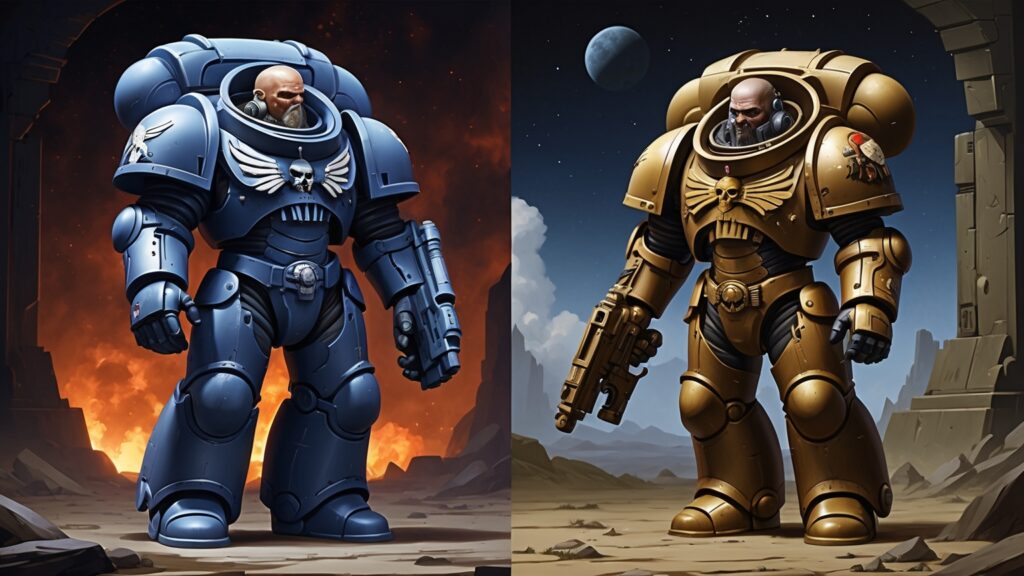
On the tabletop, Primaris Marines have replaced Firstborn as the default choice — they have an extra wound, better weapons, and more ongoing support from Games Workshop. In lore, Firstborn have ten thousand years of tradition and experience that Primaris cannot match. The practical reality is that GW is gradually phasing out Firstborn models, making Primaris the future of the Space Marines range. Whether this transition is welcome or controversial depends on who you ask — and the community has strong opinions on both sides.
The Primaris versus Firstborn debate touches on something deeper than game mechanics. It is a question about identity — what makes a Space Marine a Space Marine? Is it the gene-seed? The training? The armour mark? The ten-thousand-year legacy of service? Or is it simply the stat line on the datasheet? For many players, their Firstborn armies represent years of collecting, painting, and playing. Being told that a “better” version exists — and that the old version is being quietly retired — creates an emotional reaction that goes beyond competitive gaming.
What Is the Difference Between Primaris and Firstborn?
Primaris Space Marines are an upgraded version of the original Space Marines, developed by Archmagos Belisarius Cawl over ten thousand years of secret research. The key differences are biological — Primaris Marines have three additional implanted organs (the Sinew Coils, the Magnificat, and the Belisarian Furnace) that make them taller, stronger, and more resilient than their Firstborn counterparts. A Primaris Marine stands head and shoulders above a Firstborn and is physically superior in every measurable way.
On the tabletop, the most significant difference has historically been the Wound characteristic. Primaris Marines typically have one additional Wound compared to equivalent Firstborn models, making them significantly more durable. They also have access to newer weapon systems — bolt rifles (improved boltguns), auto bolt rifles, stalker bolt rifles, and heavy bolt pistols — that offer improved range, damage, or versatility compared to standard Firstborn equipment.
Primaris Marines also wear different armour marks. Where Firstborn wear various marks of power armour (most commonly Mark VII Aquila armour), Primaris Marines wear Mark X Tacticus, Phobos, or Gravis armour, depending on their role. These armour marks are physically larger and offer different tactical profiles — Phobos for stealth, Tacticus for general combat, and Gravis for heavy assault.
Why Did Games Workshop Create Primaris Marines?
The creation of Primaris Marines served both narrative and commercial purposes. Narratively, the Primaris project provided a mechanism for advancing the Warhammer 40,000 storyline — Roboute Guilliman’s return, the Indomitus Crusade, and the Great Rift all needed a dramatic new element, and an army of upgraded Space Marines provided exactly that.
Commercially, the Space Marine range was over twenty years old in many cases, with models that were showing their age in terms of sculpting quality and scale. Rather than simply resculpting existing units (which would have been commercially risky and narratively unexplained), GW created an entirely new generation of models with an in-universe justification for their larger size and updated aesthetics. This allowed them to sell essentially new versions of existing units to a customer base that already owned the old versions — a commercially brilliant (if controversial) strategy.
The Primaris range also established a new “true scale” for Space Marine models. Older Firstborn models were significantly smaller than the lore suggested Space Marines should be — barely taller than Imperial Guard models in many cases. Primaris models corrected this, standing appropriately tall relative to normal humans and other factions. This improved the visual coherence of the game but also highlighted how undersized the older models were.
Are Firstborn Being Phased Out?
Yes, though GW has not explicitly stated this in absolute terms. The evidence is overwhelming: no new Firstborn models have been released since Primaris were introduced, existing Firstborn kits are being progressively discontinued, and the 10th Edition rules have consolidated many Firstborn and Primaris datasheets. The writing is on the wall — Firstborn are being retired from the model range, and eventually they will be legends-only units without active rules support.
This phasing out is gradual and deliberate. GW understands that millions of players have Firstborn armies representing years of investment. An abrupt discontinuation would alienate a significant portion of their customer base. Instead, the transition is being managed over multiple editions — Firstborn remain playable, but the focus of new releases, new rules, and new narrative content is exclusively on Primaris.
Some iconic Firstborn units have already been absorbed into the Primaris range through rule consolidation. Tactical Squads, for example, function similarly to Intercessor Squads, and players can field either model on the tabletop. This consolidation allows Firstborn models to remain playable while the rules are standardised around Primaris-scale capabilities.
Which Is Better on the Tabletop?
In competitive play, Primaris Marines are generally superior. Their additional Wound makes them meaningfully more durable, their weapons are typically equal or better, and their ongoing rules support ensures that they receive new abilities and interactions with each balance update. Firstborn units that remain in the game are playable but rarely optimal — a competitive player building a new army has little reason to choose Firstborn over Primaris equivalents.
However, “better” in competitive terms is not the only consideration. Many players prefer Firstborn models for aesthetic reasons — the classic Mark VII helmets, the veteran look of older sculpts, and the kitbashing possibilities that decades of Firstborn kits provide. The Firstborn range includes options and unit types that have no direct Primaris equivalent (though this gap is shrinking with each release), and the variety of marks, accessories, and conversion possibilities makes Firstborn armies visually distinctive.
For casual and narrative play, the distinction is less important. Both Firstborn and Primaris function perfectly well in non-competitive contexts, and many gaming groups do not enforce strict competitive optimisation. A beautifully painted Firstborn army is just as enjoyable to play with and against as a Primaris army, and the narrative richness of ten thousand years of Firstborn history provides endless storytelling material.
How Do Firstborn and Primaris Interact in the Lore?
In the lore, the integration of Primaris Marines into existing Chapters has been a source of tension. Firstborn veterans — warriors who have fought and bled for centuries — were suddenly confronted with new brothers who were taller, stronger, and equipped with superior gear. The resentment was natural: these newcomers had never proven themselves in battle, yet they were physically superior to warriors who had earned their honour through decades of service.
Different Chapters handled the integration differently. The Ultramarines, ever pragmatic, accepted the Primaris relatively smoothly — Guilliman’s direct involvement ensured compliance. More traditional Chapters like the Space Wolves, Dark Angels, and Black Templars were more resistant, with cultural and doctrinal objections supplementing the personal resentment. The Space Wolves in particular struggled with the integration, as their unique gene-seed traits (the Canis Helix) created questions about whether Primaris Marines could truly be considered Sons of Russ.
Over time, the integration has progressed. Firstborn Marines can now undergo the Rubicon Primaris — a dangerous surgical procedure that upgrades a Firstborn to Primaris specifications. Several named characters have undergone the Rubicon (including Marneus Calgar, the first), providing an in-universe mechanism for existing heroes to transition to the new generation. The Rubicon is not without risk — the procedure can be fatal — but its existence ensures that beloved Firstborn characters are not abandoned as the range evolves.
What Should New Players Choose?
New players should generally choose Primaris. The models are newer, better proportioned, easier to build (with push-fit options available), and will receive continued rules support for the foreseeable future. The Primaris range covers every battlefield role — troops, elites, fast attack, heavy support, and HQ — and provides a comprehensive army that does not require any Firstborn supplementation.
The exception is if a new player has a strong aesthetic preference for the Firstborn look or wants to build a specific army theme that requires Firstborn models (such as a pre-Rift Crusade-era force or a specific Chapter’s traditional equipment). In these cases, Firstborn models are still available and still playable, and the aesthetic satisfaction of building the army you want is more important than statistical optimisation.
Frequently Asked Questions
Can I mix Primaris and Firstborn in the same army?
Yes. Both Primaris and Firstborn units share the Space Marines faction keyword and can be included in the same army. Many players field mixed forces, combining their existing Firstborn collection with new Primaris additions. There is no rules penalty for mixing the two generations.
Will Firstborn ever get new models?
Almost certainly not. GW has not released a new Firstborn kit since the introduction of Primaris Marines, and all design resources are focused on the Primaris range. Existing Firstborn kits will continue to be available until they are discontinued, but new Firstborn models are extremely unlikely.
Are Firstborn and Primaris the same Chapter?
Yes. Primaris Marines are recruited, trained, and assigned to the same Chapters as Firstborn Marines. An Ultramarines Intercessor and an Ultramarines Tactical Marine are both Ultramarines — they share the same Chapter culture, heraldry, and gene-seed lineage. The difference is biological (the additional Primaris organs) and equipment-based (Mark X armour and new weapons), not organisational.
What is the Rubicon Primaris?
The Rubicon Primaris is a surgical procedure that can upgrade a Firstborn Marine to Primaris specifications — implanting the three additional organs and modifying the Marine’s physiology to match Primaris standards. The procedure is dangerous and can be fatal, but successful recipients gain the full advantages of Primaris biology. Several named characters, including Marneus Calgar and Kor’sarro Khan, have undergone the Rubicon.
Related Content
- Chaos Knights Army Guide — explore the army behind the lore
- The Horus Heresy Explained — Complete Timeline & Guide — understand the pivotal Horus Heresy era
- Best Warhammer Books to Read — Fiction Guide — find great Warhammer novels to read
- Warhammer Etiquette Guide — Sportsmanship & Table Manners — explore more Warhammer content