

The best all-round primer for most Warhammer painters is Vallejo Surface Primer, because it brushes on or goes straight through an airbrush and never depends on the weather. If you want speed, an Army Painter Colour Primer spray can is the easiest start, and a bone or white primer (Army Painter Skeleton Bone, or Citadel Wraithbone from a Games Workshop store) is the one to pick for Contrast and Speedpaint. Your choice of primer directly affects paint adhesion, colour vibrancy, and the overall quality of your finished models.
Primer is the foundation of every paint job. Skip it or use the wrong product and you’ll spend hours fighting peeling paint, chalky textures, and colours that never look quite right. This guide covers every primer method, the best brands, colour theory, and the mistakes that ruin miniatures before you even pick up a brush.
Our Top Picks at a Glance
Our picks are based on manufacturer specs, the Amazon listings and what painters commonly use – we explain the reasoning for each below.
| Product | Type | Price | ||
|---|---|---|---|---|
 | Vallejo Surface Primer Grey (200ml) Best Overall | Bottled acrylic – brush or airbrush | $19.43 as of Nov 14, 2026 2:32 PM PST | Buy on Amazon |
 | The Army Painter Colour Primer – Matt Black Best for Beginners | Acrylic spray can, 400ml | $17.50 as of Nov 14, 2026 2:32 PM PST | Buy on Amazon |
 | The Army Painter Colour Primer – Skeleton Bone Best for Contrast & Speedpaint | Acrylic spray can, 400ml | $20.50 as of Nov 14, 2026 2:32 PM PST | Buy on Amazon |
 | Badger Stynylrez Primer 3-Tone Pack (White, Grey, Black) Best for Airbrush & Zenithal | Bottled acrylic-polyurethane, airbrush | $22.30 as of Nov 14, 2026 2:32 PM PST | Buy on Amazon |
Prices are from Amazon.com (US) at the time shown. Product prices and availability are accurate as of the date/time indicated and are subject to change. Any price and availability information displayed on Amazon.com at the time of purchase will apply to the purchase of this product. As an Amazon Associate, Warhammer Guild earns from qualifying purchases.
The Best Primers for Miniatures (2026)
1. Vallejo Surface Primer Grey (200ml) – Best Overall

Price details
Product prices and availability are accurate as of the date/time indicated and are subject to change. Any price and availability information displayed on Amazon.com at the time of purchase will apply to the purchase of this product.As an Amazon Associate, Warhammer Guild earns from qualifying purchases.
Vallejo Surface Primer is the most flexible primer on this list. It is made to go straight through an airbrush, it brushes on neatly for a handful of models, and because you use it indoors you never have to wait for a dry, mild day. Grey is the most forgiving colour for both bright and dark schemes.
Best for: Painters who want one primer for brush now and airbrush later.
| Type | Water-based acrylic surface primer |
|---|---|
| Size | 200ml bottle with dropper (also 18ml and 60ml) |
| Application | Airbrush (Vallejo suggests 15–20 PSI) or brush |
| Thinning | Use neat, or thin with Vallejo Airbrush Thinner / Flow Improver |
| Finish | Matt |
Why we like it
- Ready to airbrush from the bottle – Vallejo recommends around 15–20 PSI
- Works by brush too, so it is useful before you own an airbrush
- Vallejo says it dries to a hard, resistant film within a few hours
- No weather worries – no blooming, no gritty texture from cold cans
- Excellent detail preservation when sprayed thin
- Big 200ml bottle lasts a long time
- Comes in many colours and three bottle sizes
- Slower than a spray can for a whole army by brush
- Needs a thorough shake, and two thin coats when brushed
2. The Army Painter Colour Primer – Matt Black – Best for Beginners

Price details
Product prices and availability are accurate as of the date/time indicated and are subject to change. Any price and availability information displayed on Amazon.com at the time of purchase will apply to the purchase of this product.As an Amazon Associate, Warhammer Guild earns from qualifying purchases.
Army Painter’s Colour Primer is made specifically for miniatures and is the easiest way to prime a whole squad in minutes. Matt Black gives deep shadows for free, makes metallics look rich, and hides any spots your brush misses later.
Best for: New painters priming squads quickly with a rattle can.
| Type | Acrylic aerosol primer |
|---|---|
| Size | 400ml can |
| Finish | Matt |
| Spray distance | 15–20cm (per Army Painter) |
| Surfaces | Plastic, resin and metal |
Why we like it
- Designed for miniatures, with a fine spray that Army Painter says preserves sculpted detail
- Clear instructions on the can: shake for a minute, spray from 15–20cm in short bursts
- Sold on Amazon by Army Painter itself, at a sensible price
- Works under Warpaints, Speedpaint and other acrylics
- Fastest way to prime lots of models
- Forgiving black base for beginners
- Large 400ml can
- Weather-dependent, like every spray can
- Bright colours need more coats over black
3. The Army Painter Colour Primer – Skeleton Bone – Best for Contrast & Speedpaint

Price details
Product prices and availability are accurate as of the date/time indicated and are subject to change. Any price and availability information displayed on Amazon.com at the time of purchase will apply to the purchase of this product.As an Amazon Associate, Warhammer Guild earns from qualifying purchases.
Translucent paints like Contrast and Speedpaint need a light undercoat to glow, and a warm bone shade is the classic choice. Skeleton Bone does the same job as Citadel’s Wraithbone, and it is sold directly by Army Painter on Amazon rather than through resellers.
Best for: Contrast, Speedpaint and bone-heavy undead or desert schemes.
| Type | Acrylic aerosol primer |
|---|---|
| Size | 400ml can |
| Colour | Warm bone |
| Finish | Matt |
| Spray distance | 15–20cm (per Army Painter) |
Why we like it
- Light, warm base that makes one-coat paints look bright and clean
- Doubles as a finished basecoat for bone, horns, teeth and skeletons
- Same miniature-specific formula as the rest of the Colour Primer range
- A good partner for black primer if you want to try zenithal
- Ideal under Speedpaint and Contrast
- Saves a basecoat step on undead armies
- Less stark than pure white
- Missed spots show more than on black
- Not the right base for very dark schemes
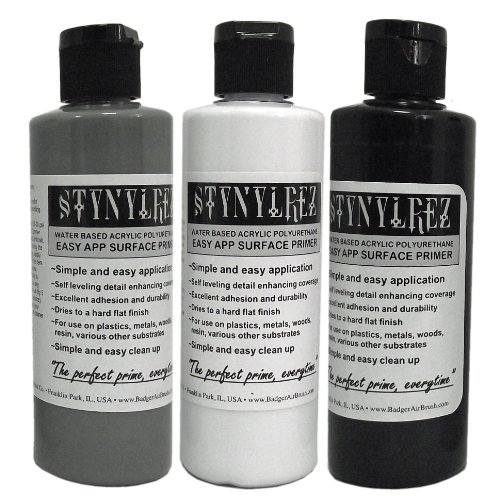
4. Badger Stynylrez Primer 3-Tone Pack (White, Grey, Black) – Best for Airbrush & Zenithal
Price details
Product prices and availability are accurate as of the date/time indicated and are subject to change. Any price and availability information displayed on Amazon.com at the time of purchase will apply to the purchase of this product.As an Amazon Associate, Warhammer Guild earns from qualifying purchases.
Stynylrez is a favourite with airbrush painters because it is self-levelling and goes on very thin, so fine detail stays crisp. This pack gives you black, grey and white together – everything you need to zenithal prime without buying three separate bottles.
Best for: Airbrush owners and zenithal priming.
| Type | Water-based acrylic-polyurethane primer |
|---|---|
| Colours | White, grey and black |
| Size | 4oz bottles (per listing) |
| Surfaces | Plastic, metal, resin, wood |
| Finish | Hard, flat |
Why we like it
- Self-levelling formula that Badger says dries to a hard, flat finish
- Bonds to plastic, metal and resin
- Three tones in one pack for black-then-white zenithal or grey-and-white highlights
- Badger says it can be sprayed straight from the bottle
- Very thin, even coat through an airbrush
- Durable surface that handles well
- Easy water clean-up
- Needs an airbrush to get the best from it
- Can be ruined if it freezes in transit – Badger warns about cold-weather delivery
What Is Primer and Why Do Miniatures Need It?
Primer is a specially formulated paint that bonds to bare plastic, resin, or metal and creates a slightly rough, porous surface that subsequent paint layers grip onto. Without primer, acrylic miniature paints will bead up, rub off with handling, and chip at the slightest contact.
Miniature primer differs from hardware-store primer in several important ways. It’s formulated with finer pigment particles that won’t obscure surface detail, it dries to a thinner film, and it’s designed to work with the small scale of 28-32mm models. Using the wrong primer — such as thick automotive primer — is one of the most common beginner mistakes and can obliterate the fine details that make Warhammer models look impressive.
Every miniature you paint should be primed, regardless of material. Plastic, resin, metal, and 3D-printed models all benefit from a proper primer coat. The only exception is pre-primed models like some Wizkids D&D miniatures, which come factory-primed.
What Are the Different Methods of Priming Miniatures?
Spray Can Primer
Spray cans are the most popular priming method for Warhammer hobbyists. They’re fast, require no extra equipment, and produce a consistent coat when used correctly. A single can will prime 30-60 infantry models or 10-15 vehicles depending on size.
The technique is straightforward: hold the can roughly 15–30cm from the model (Army Painter recommends 15–20cm for its Colour Primers – always check the can), shake it for at least a minute, use short sweeping bursts rather than sustained sprays, and rotate the model between passes. Two thin coats are always better than one thick coat. Spray in a well-ventilated area or outdoors, and always use a spray stick or holder to avoid coating your fingers.
The main drawback of spray cans is weather dependency. Temperature below 15°C (59°F) or above 30°C (86°F) causes problems, as does humidity above 60%. Cold weather makes the propellant sluggish and produces a grainy, textured finish. High humidity causes moisture to get trapped in the primer layer, creating a frosted or chalky appearance that ruins surface detail.
Brush-On Primer
Brush-on primer is the most accessible method since it requires no special equipment beyond a large basecoat brush. It works in any weather, produces no fumes in your workspace, and gives you precise control over coverage.
The best brush-on primers are bottled surface primers such as Vallejo Surface Primer and Badger Stynylrez. Citadel Base paints cover well on clean plastic, but they are not true primers (see the FAQ below). Apply in thin, even coats and avoid overloading the brush. Two thin coats with 15-20 minutes drying time between them gives better results than one thick coat.
The disadvantage is speed. Brush-priming a full army of 50+ models is tedious work, and it’s harder to achieve the perfectly even coat that spray or airbrush methods deliver. Brush strokes can also show on large flat surfaces like vehicle panels.
Airbrush Primer
Airbrush priming is the gold standard. It produces the thinnest, smoothest, most even primer coat possible while preserving maximum surface detail. It works in any weather since you’re spraying indoors, and you have complete control over paint flow and coverage.
Vallejo Surface Primer is the go-to choice for airbrush users because it’s pre-thinned to the correct consistency and comes in a dropper bottle. Vallejo recommends around 15–20 PSI, and a 0.3–0.5mm needle works well. It dries quickly, and Vallejo says it forms a hard, resistant film within a few hours.
The barrier to entry is cost. A basic airbrush setup (compressor, airbrush and primer) is a significant investment for beginners – see our best airbrush for Warhammer guide for options. However, if you plan to paint regularly, it pays for itself in time saved and quality gained.
What Colour Primer Should You Use?
Black Primer
Black primer is the most forgiving colour for beginners. Any spots you miss with your brush become natural shadows, and dark colour schemes (Black Templars, Iron Hands, Nighthaunt) look great over black. It also makes metallics pop — silver and gold paints over black primer have a richer, deeper appearance than over white.
The downside is that bright colours require multiple coats to achieve full opacity over black. Yellow, white, and light blues can need 3-5 coats, which is frustrating and risks obscuring detail.
White Primer
White primer makes every colour brighter and more vibrant with fewer coats. It’s essential for Contrast paint workflows and any scheme with large areas of yellow, white, or bright colours. It also makes it easier to see surface detail while painting.
The trade-off is that missed spots show as glaring white patches rather than blending into shadows, and white primer is less forgiving of a sloppy spray technique — pooling and texture are more visible on white.
Grey Primer
Grey is the best compromise between black and white. It provides a neutral base that works with both bright and dark colours, hides imperfections better than white, and doesn’t require as many coats as black for bright colours. Many competition painters use grey as their default.
Zenithal Priming
Zenithal priming combines black and white primer to pre-shade your model. Prime the entire model black, then spray white from directly above (the zenith). This creates a natural gradient from shadow to highlight that shows through translucent paints like Contrast or Speedpaints, giving instant depth with minimal effort.
For the full method, see our zenithal priming guide. This technique has become hugely popular because it produces impressive tabletop-quality results quickly. It works best with an airbrush for smooth transitions, but you can achieve a serviceable version with spray cans.
How to Choose a Primer for Miniatures
Spray, brush or airbrush? A spray can is fastest for whole squads but needs dry, mild weather. A bottled primer such as Vallejo Surface Primer works with a brush today and an airbrush later, indoors, all year round. If you already airbrush, a dedicated airbrush primer like Badger Stynylrez gives the thinnest coat of all.
Pick the colour for your scheme. Black suits dark armies and metallics, grey is the safest all-rounder, and white or bone is best under Contrast and Speedpaint. Coloured primers – Army Painter makes a large range – can double as your basecoat.
What about Citadel? Games Workshop’s Chaos Black, Wraithbone and Grey Seer sprays are excellent and made for GW plastic, but on Amazon they are usually listed by third-party resellers at a mark-up. Buy them from a Warhammer store or local stockist instead, and use the picks above when ordering online.
Hardware-store primer. Rust-Oleum and Montana Gold cans are fine for terrain and big vehicles, but they spray heavier than hobby primers. Test on a spare sprue first – our best spray paint for miniatures guide compares the spray cans in more depth.
Bottle sizes. Vallejo Surface Primer comes in 18ml, 60ml and 200ml bottles; the small sizes are a cheap way to try a colour before committing.
How Do Temperature and Humidity Affect Spray Priming?
The ideal conditions for spray priming are 20-25°C (68-77°F) with relative humidity below 50%. Outside this range, you risk the following problems:
Cold weather (below 15°C / 59°F): The propellant doesn’t atomise properly, producing large droplets that create a rough, sandy texture. The primer also takes much longer to cure, increasing the risk of runs and pooling.
Hot weather (above 30°C / 86°F): The primer dries mid-flight before hitting the model, creating a dusty, powdery finish that doesn’t bond properly. It can also cause the primer to dry too quickly on the model surface, preventing it from self-levelling.
High humidity (above 60%): Moisture gets trapped in the primer layer as it dries, causing a frosted white appearance known as “blooming” or “fogging.” This is the most common spray primer disaster and can require stripping and re-priming the model.
If you live in a climate with unreliable weather, an airbrush or brush-on primer eliminates these problems entirely since you’re working indoors in a controlled environment.
What Are the Most Common Priming Mistakes?
Spraying too close: Holding the can too close causes pooling and obscures detail. Keep to the distance printed on the can – usually somewhere between 15 and 30cm.
Spraying too thick: One heavy coat is worse than two light ones. If you can’t see surface texture through the primer, it’s too thick.
Not shaking the can enough: Shake spray cans vigorously for at least one to two minutes (Army Painter says at least one). The mixing ball should rattle freely. Poorly mixed primer produces inconsistent coverage and texture.
Priming in bad weather: Check temperature and humidity before every spray session. A ruined primer coat wastes the model and your time.
Skipping primer entirely: Some beginners try painting directly onto plastic. The paint will bead up, chip off, and look terrible. Always prime.
Using automotive or wood primer: These products are formulated for large surfaces and spray far too thick for miniature detail. Stick to hobby-specific or fine-art primers.
Not cleaning models first: Mould release agent on new plastic can prevent primer from bonding. Wash sprues in warm soapy water and let them dry completely before priming. This is especially important for resin models from Forge World.
How Do You Strip Primer If Something Goes Wrong?
If your primer coat goes wrong — too thick, textured, frosted — you can strip it and start over. Soak plastic models in isopropyl alcohol (90%+) or a dedicated paint stripper like Biostrip 20 for 12-24 hours, then scrub with an old toothbrush. For metal models, acetone works but will damage plastic. Never use acetone on plastic or resin.
Our guide to stripping paint from miniatures covers every method in detail. Dettol (brown antiseptic) is a popular UK stripping solution — soak overnight and scrub. The paint comes off in rubbery sheets. Be warned that it smells terrible and the residue is sticky if you don’t rinse thoroughly.
Frequently Asked Questions
Can you use Citadel Base paints as primer?
Citadel Base paints are designed to be high-opacity and work reasonably well directly on clean plastic, but they are not true primers. They lack the bonding agents that proper primer contains, so paint durability will be reduced compared to priming first. For best results, always use actual primer.
How long should primer dry before painting?
Allow spray primer to dry for at least 30-60 minutes before painting, though most primers are touch-dry in 10-15 minutes. In cold or humid conditions, extend drying time to 2+ hours. Brush-on primer like Vallejo Surface Primer is touch-dry quickly, and Vallejo says it hardens fully within a few hours. If in doubt, leave any primer overnight before heavy handling.
Is expensive primer worth it over cheap alternatives?
For infantry and detailed character models, yes — hobby primers like Citadel and Vallejo produce noticeably thinner, more consistent coats that preserve fine detail. For terrain, vehicles, and bulk projects, budget primers like Montana Gold or Rustoleum work perfectly well and save significant money.
Do you need to prime 3D-printed miniatures differently?
Resin 3D prints should be washed in isopropyl alcohol and UV-cured before priming. FDM prints may need sanding to reduce layer lines. Both benefit from a coat of Vallejo Surface Primer applied by airbrush, which fills minor surface imperfections. Spray cans also work but won’t hide layer lines on FDM prints.
How many models can one spray can prime?
A standard 400ml hobby can (Army Painter Colour Primer, Vallejo Hobby Paint Spray or Citadel) will prime roughly 30–60 infantry models or 10–15 vehicles, depending on your technique. Always have a backup can for large batch-priming sessions.
What is the best brush-on primer for miniatures?
Vallejo Surface Primer is the best brush-on primer for most painters, because it brushes on neatly and can go through an airbrush later. Badger Stynylrez also brushes on well. Apply two thin coats with 15 to 20 minutes’ drying time between them. Citadel Base paints cover clean plastic well, but they are not true primers, so they will not grip as strongly.
What primers does Games Workshop make?
Games Workshop sells Citadel spray primers, including Chaos Black, Wraithbone, Grey Seer and Corax White, plus coloured and metallic sprays such as Leadbelcher and Retributor Armour. It also makes Imperial Primer, a pot of black primer you apply with a brush. The sprays are excellent on GW plastic, but buy them from a Warhammer store or local stockist, because Amazon listings are often reseller mark-ups.
What is the best primer for metal miniatures?
Any good hobby primer that lists metal as a surface works on metal miniatures. The Army Painter Colour Primers and Badger Stynylrez both bond to metal. Prep matters more than the brand: wash the model in warm soapy water to remove mould release, let it dry fully, then apply thin coats. Black or grey primer is a good choice if the model will end up mostly metallic.
Is there a metallic primer for Warhammer?
Yes. Citadel makes Leadbelcher (silver) and Retributor Armour (gold) sprays, and The Army Painter has metallic Colour Primers such as Plate Mail Metal. They work as primer and basecoat in one, which saves a lot of time on armour-heavy armies like Iron Hands or Adeptus Custodes. Finish with a shade such as Nuln Oil or Reikland Fleshshade, then highlight the edges.
Related Content
- Warhammer Painting for Beginners — Everything You Need — essential painting guide for new hobbyists
- Best Paints for Warhammer — Complete Comparison Guide — recommended paints for Warhammer miniatures
- Object Source Lighting (OSL) — Complete Miniature Painting Guide — related painting technique and tutorial
- Drybrushing Tutorial — Fast Painting for Warhammer — popular drybrushing technique tutorial