

Airbrushing has revolutionized the Warhammer hobby. What once took hours of careful layering with a standard brush can now be accomplished in minutes with smooth, even coverage that’s nearly impossible to achieve by hand. Whether you’re looking to speed up basecoating entire armies, achieve stunning zenithal highlights, or create seamless blending on display pieces, an airbrush is one of the best investments you can make in your hobby toolkit.
But with dozens of airbrush models on the market at wildly different price points, choosing the right one can feel overwhelming — especially if you’ve never used one before. In this comprehensive guide, we’ll break down exactly which airbrushes are best for miniature painting, what to look for in a compressor, and how to get started without wasting money on gear you don’t need.
Our Top Picks at a Glance
Our picks are based on manufacturer specs, the Amazon listings and what painters commonly use – we explain the reasoning for each below.
| Product | Key spec | Price | ||
|---|---|---|---|---|
 | Iwata Eclipse HP-CS Best Overall | 0.35mm nozzle, 7ml gravity cup | $174.00 as of Nov 14, 2026 6:35 PM PST | Buy on Amazon |
 | Harder & Steenbeck Evolution 2024 CRplus (0.45mm) Best Premium | 0.45mm FineLine nozzle, 5ml cup | $169.94 as of Nov 14, 2026 6:35 PM PST | Buy on Amazon |
 | Iwata Neo CN Best Budget | Entry-level Iwata, 7ml + 3ml cups | $69.99 as of Nov 14, 2026 6:35 PM PST | Buy on Amazon |
 | Master Airbrush Cool Runner II TC-326T Best Compressor | 3L tank, 47 dB, regulator + water trap | $139.99 as of Nov 14, 2026 6:35 PM PST | Buy on Amazon |
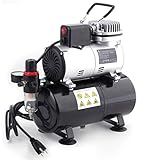 | Timbertech ABPST08 Best Budget Compressor | 3L tank, 47 dB, cooling fan | $86.99 as of Nov 14, 2026 6:35 PM PST | Buy on Amazon |
Prices are from Amazon.com (US) at the time shown. Product prices and availability are accurate as of the date/time indicated and are subject to change. Any price and availability information displayed on Amazon.com at the time of purchase will apply to the purchase of this product. As an Amazon Associate, Warhammer Guild earns from qualifying purchases.
The Best Airbrushes and Compressors for Miniatures (2026)
1. Iwata Eclipse HP-CS – Best Overall

Price details
Product prices and availability are accurate as of the date/time indicated and are subject to change. Any price and availability information displayed on Amazon.com at the time of purchase will apply to the purchase of this product.As an Amazon Associate, Warhammer Guild earns from qualifying purchases.
The Eclipse HP-CS is the airbrush you will see recommended most often for miniatures, and it earns that spot. Its 0.35mm set-up is fine enough for zenithal highlights and soft blends on infantry, yet flows enough paint to basecoat a tank without fuss.
Best for: Most miniature painters, from first army to display pieces.
| Type | Dual-action, gravity-feed |
|---|---|
| Nozzle | E3 compression-fit (0.35mm) |
| Cup | 0.24 oz (7ml) |
| Needle | Spring-steel, solvent-resistant packings |
| Handle | Cutaway for quick needle access |
Why we like it
- 0.35mm is the sweet spot for 28–32mm models – detail and coverage from one brush
- Iwata says its high-flow design atomises well with less thinning, which suits hobby acrylics
- Compression-fit E3 nozzle (no threads) and a cutaway handle make cleaning simpler
- Spare parts and upgrades are easy to find almost anywhere
- Proven, reliable workhorse
- Handles primer, basecoats and varnish
- Easy to strip down and clean
- Not the cheapest way into airbrushing
- 0.35mm is not a dedicated ultra-fine detail brush
2. Harder & Steenbeck Evolution 2024 CRplus (0.45mm) – Best Premium

Price details
Product prices and availability are accurate as of the date/time indicated and are subject to change. Any price and availability information displayed on Amazon.com at the time of purchase will apply to the purchase of this product.As an Amazon Associate, Warhammer Guild earns from qualifying purchases.
The Evolution has long been the European favourite, and the 2024 CRplus version brings H&S’s FineLine nozzle and a new cam mechanism to smooth out the trigger. The 0.45mm set-up in this listing is a great general-purpose size for priming, basecoats and big blends.
Best for: Painters who want one premium German airbrush that can grow with them.
| Type | Dual-action, gravity-feed |
|---|---|
| Nozzle | 0.45mm FineLine, self-centring |
| Cup | 5ml with lid |
| Seals | PTFE |
| Assembly | Tool-free strip-down |
Why we like it
- Self-centring nozzle removes one of the most common causes of a bad spray pattern
- Strips down entirely by hand – no tools needed to clean or swap nozzles
- H&S says the Speed Clean trigger gives about 20% more needle travel for faster flushing between colours
- Other Evolution nozzle sets (finer and wider) fit the same body, so you can add a fine-detail set later
- Excellent build quality and trigger feel
- Very easy to maintain
- Modular – upgrade rather than replace
- Priced at the premium end
- Smaller 5ml cup means more refills on big models
- Trigger feel differs from Iwata – some prefer one or the other
3. Iwata Neo CN – Best Budget

Price details
Product prices and availability are accurate as of the date/time indicated and are subject to change. Any price and availability information displayed on Amazon.com at the time of purchase will apply to the purchase of this product.As an Amazon Associate, Warhammer Guild earns from qualifying purchases.
The Neo CN is Iwata’s entry-level airbrush, and it is the safest cheap airbrush for a first-timer. It is a genuine dual-action brush from a major maker, so the skills you learn transfer straight to an Eclipse or H&S later.
Best for: Trying airbrushing without a big outlay.
| Type | Dual-action, gravity-feed |
|---|---|
| Cups | Detachable 7ml (with lid) and 3ml |
| Designed for | Smooth spraying at low air pressure |
| Brand | Iwata (entry-level range) |
Why we like it
- Proper dual-action trigger, so you learn real airbrush control from day one
- Two detachable cups – the small 3ml one is handy for quick highlights
- Iwata designed it to spray smoothly at lower pressures, which suits small compressors
- A big step up from the unbranded airbrushes bundled with cheap kits
- Low cost for a name-brand airbrush
- Simple to learn and clean
- Good for priming and basecoating
- Not as refined as the Eclipse for fine work
- Fewer upgrade parts than Iwata’s premium ranges
4. Master Airbrush Cool Runner II TC-326T – Best Compressor

Price details
Product prices and availability are accurate as of the date/time indicated and are subject to change. Any price and availability information displayed on Amazon.com at the time of purchase will apply to the purchase of this product.As an Amazon Associate, Warhammer Guild earns from qualifying purchases.
Your airbrush is only as good as the air behind it. The TC-326T ticks every box that matters for miniatures: a 3-litre tank for smooth, pulse-free air, a regulator with gauge, a moisture trap, and auto shut-off so the motor rests when the tank is full.
Best for: A quiet, tank-equipped compressor for long painting sessions.
| Motor | 1/5 HP single piston, 2 cooling fans |
|---|---|
| Tank | 3 litre |
| Air flow | 25 L/min (0.8 CFM) |
| Noise | 47 dB (maker’s figure) |
| Auto on/off | On at 43 psi, off at 57 psi |
| Included | Regulator with gauge, water trap, hose, holder for 2 airbrushes |
Why we like it
- Tank smooths out pulsing and lets the motor switch off between bursts
- Twin cooling fans let it run longer without overheating, according to Master Airbrush
- Quoted at 47 dB – quiet enough for a spare room or shared space
- Comes with the hose and an airbrush holder, so it is ready to go
- All the must-have features in one box
- Quiet for a piston compressor
- Holder for two airbrushes
- Heavier and bulkier than tankless mini compressors
- Airbrush sold separately
5. Timbertech ABPST08 – Best Budget Compressor
Price details
Product prices and availability are accurate as of the date/time indicated and are subject to change. Any price and availability information displayed on Amazon.com at the time of purchase will apply to the purchase of this product.As an Amazon Associate, Warhammer Guild earns from qualifying purchases.
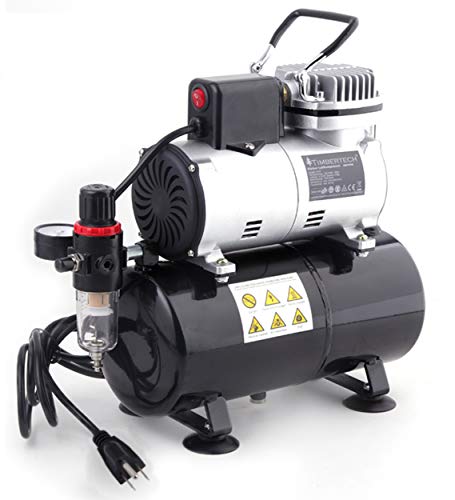
If the Master Airbrush stretches the budget, the Timbertech gives you the same core features – a 3-litre tank, regulator, gauge and moisture trap – for less. Pair it with the Neo CN for a sensible, low-cost starter setup.
Best for: A tank compressor on a tighter budget.
| Type | Oil-free single piston with cooling fan |
|---|---|
| Tank | 3 litre |
| Air flow | 20–23 L/min |
| Noise | 47 dB (maker’s figure) |
| Safety | Overheat protector, pressure-relief valve |
| Included | Regulator with gauge, water trap and air filter |
Why we like it
- Has the tank, regulator and water trap that cheap tankless pumps lack
- Cooling fan and overheat protection for longer sessions
- Timbertech rates it at 47 dB, so it is quiet enough indoors
- Works with airbrushes from 0.2 to 0.8mm, so it suits any brush on this list
- Strong feature list for the price
- Compact with a carry handle
- Pulse-free air thanks to the tank
- Airbrush sold separately
- Slightly lower air flow than the Master Airbrush TC-326T
How to Choose an Airbrush for Miniatures
Dual-action, gravity-feed. Push down for air, pull back for paint – a dual-action trigger is what lets you feather highlights and fade colours. Gravity-feed (a cup on top) needs less air pressure and wastes less paint than siphon-feed bottles. Every airbrush on this list is both.
Nozzle size: start at 0.3–0.45mm. This range basecoats, primes and highlights 28mm models comfortably. You can add a fine 0.2mm set-up or a 0.5mm priming brush later – see the needle-size guide below.
Buy the compressor properly. A tank, a regulator with a gauge and a moisture trap are non-negotiable. Avoid very cheap all-in-one kits whose unbranded airbrushes have loose tolerances – they make learning harder, not easier.
Other good options. The Badger Patriot 105 is a sturdy US-made beginner brush with a forgiving 0.5mm needle, and the Harder & Steenbeck Ultra 2024 is a cheaper way into the H&S system – both are worth a look if you find them in stock at a fair price. New to airbrushing? Our airbrush tutorial for miniatures walks you through your first session.
Choosing a Compressor
Your airbrush is only half the equation — you also need a reliable compressor to supply consistent air pressure. Here’s what to look for:
Key Compressor Features for Miniature Painting
- Moisture trap: Essential. Water in your air line will spit droplets onto your models and ruin your work. Every compressor you consider should have one.
- Pressure regulator: Allows you to dial in the exact PSI you need for different tasks. Non-negotiable.
- Air tank: A compressor with a tank delivers smoother, more consistent airflow. Tankless compressors pulse slightly, which can cause uneven paint application. A tank also means the motor doesn’t run constantly, reducing noise and extending the compressor’s lifespan.
- Noise level: Hobby compressors should run at 50-60 dB or less. You’ll often be airbrushing for extended sessions, and a loud compressor will drive you (and anyone else in your home) crazy.
- Auto-shutoff: Compressors with tanks should automatically shut off when the tank is full and restart when pressure drops. This extends motor life significantly.
Recommended Compressors
The Master Airbrush TC-326T (pick 4 above) is our choice for most hobbyists: a 3-litre tank, regulator, moisture trap and auto shut-off in one quiet unit. If budget is tight, the Timbertech ABPST08 (pick 5) offers the same core features for less. At the premium end, Sparmax and Iwata branded compressors are excellent but cost noticeably more for small gains in hobby use.
PSI Settings for Miniature Painting
Getting your air pressure right is crucial for good results. Here are the recommended PSI ranges for common Warhammer airbrushing tasks:
| Task | Recommended PSI | Notes |
|---|---|---|
| Priming | 25–30 PSI | Higher pressure for thicker primer consistency |
| Basecoating | 18–25 PSI | Standard working pressure for most paints |
| Layering / Highlighting | 12–18 PSI | Lower pressure for finer control and softer transitions |
| Fine Detail | 8–15 PSI | Low pressure with thin paint for precise work |
| Varnishing | 20–25 PSI | Moderate pressure for even varnish coverage |
These are starting points — you’ll develop your own preferred settings as you gain experience. The key principle is: thinner paint = lower pressure, thicker paint = higher pressure.
Needle Sizes Explained
Airbrush needle size determines how fine a line you can spray and how much paint flows through the airbrush. Here’s a quick guide:
- 0.15–0.2mm: Ultra-fine detail. Best for freehand designs, eyes, tiny details. Requires very thin paint. Clogs easily if paint isn’t properly thinned.
- 0.3–0.4mm: The sweet spot for miniature painting. Handles basecoating, layering, highlighting, and moderate detail work. This is the range most hobbyists should start with.
- 0.5mm: Great for priming, basecoating vehicles and large models, and terrain. More forgiving with paint consistency but less capable of fine work.
If you’re buying your first airbrush, a 0.3–0.4mm needle is the ideal starting point. You can always add a dedicated detail airbrush (0.2mm) or a priming workhorse (0.5mm) later as your needs evolve.
Priming with an Airbrush
One of the most immediately impactful uses of an airbrush is priming your models. Airbrush priming offers several advantages over spray cans:
- Thinner, more even coats: Airbrush primer goes on much thinner than rattle cans, preserving fine detail on your models
- Weather-independent: No more waiting for the right temperature and humidity — airbrush indoors any time
- Cost-effective: A bottle of airbrush primer lasts much longer than equivalent spray cans
- Colour flexibility: Easy to prime in any colour, including custom mixes for specific colour schemes
For more on choosing a primer, see our best primer for miniatures guide.
Recommended Primers for Airbrush
- Vallejo Surface Primer: The gold standard. Available in multiple colours, excellent adhesion, sprays beautifully through an airbrush at 20–25 PSI. Use it straight from the bottle or thin slightly with Vallejo Airbrush Thinner.
- Badger Stynylrez: Another outstanding option. Self-leveling formula that’s practically foolproof. Comes in black, white, and grey.
- AK Interactive 3rd Gen Primer: Excellent coverage and adhesion. The grey primer is particularly popular.
Zenithal Highlighting with an Airbrush
Zenithal highlighting (also called zenithal priming or pre-shading) is a technique where you prime your model in black, then spray white or grey from above at roughly a 45-degree angle to simulate overhead lighting. This creates natural-looking shadows and highlights before you even start painting.
How to Zenithal Prime
- Prime entirely in black: Cover the whole model evenly with black primer
- Allow to dry: Give the black primer 15–20 minutes to fully cure
- Spray grey from 45 degrees: (Optional) Hit the model with grey primer from a 45-degree angle above, leaving the deepest recesses black
- Spray white from directly above: Hit the very top surfaces — tops of heads, shoulder pads, upper surfaces — with white primer
- Paint with thin, translucent layers: Apply your colours in thin coats so the zenithal shading shows through, creating instant depth
Zenithal highlighting pairs exceptionally well with Contrast paints and other translucent paints, as the underlying light/dark values show through to create natural-looking shading with minimal effort. It’s one of the fastest ways to achieve professional-looking results on an entire army. Our zenithal priming guide covers the technique step by step.
Cleaning Your Airbrush
Proper cleaning is the single most important maintenance habit for airbrush longevity. A poorly cleaned airbrush will clog, spit, and eventually become unusable. Here’s a reliable cleaning routine:
Between Colours (Quick Clean)
- Empty remaining paint from the cup
- Add airbrush cleaner or water to the cup
- Spray through onto a paper towel until the spray runs clear
- Wipe the cup with a cotton bud
- Repeat if needed until completely clear
End of Session (Deep Clean)
- Perform a quick clean as above
- Remove the needle (pull straight back gently)
- Remove the nozzle (use the wrench that came with your airbrush — never use pliers)
- Soak the nozzle in airbrush cleaner for a few minutes
- Clean the inside of the airbrush body with cleaning brushes and airbrush cleaner
- Wipe the needle clean with a lint-free cloth (wipe from back to front to avoid bending the tip)
- Reassemble and spray clean water through to verify
Recommended cleaners: Iwata Medea Airbrush Cleaner, Vallejo Airbrush Cleaner, or Createx Restorer for stubborn dried paint. In a pinch, isopropyl alcohol (99%) works well but can be harsh on seals in cheaper airbrushes.
Common Beginner Mistakes to Avoid
- Paint too thick: The number one cause of clogging and frustration. Airbrush paint should be the consistency of milk. When in doubt, thin it more.
- Spraying too close: Keep at least 3–6 inches between the airbrush and the model. Spraying too close causes pooling and runs.
- Not using a spray booth or extraction: Airbrush mist gets everywhere. A simple spray booth with extraction (even a DIY one with a bathroom fan) protects your health and keeps your workspace clean.
- Skipping moisture traps: Moisture in the air line causes splatters. Always use a moisture trap between your compressor and airbrush.
- Over-spraying in one spot: Keep the airbrush moving. Short, sweeping passes build up colour gradually without pooling.
- Neglecting cleaning: Clean between every colour change and deep clean at the end of every session. Five minutes of cleaning saves hours of frustration from clogs.
Frequently Asked Questions
Do I really need an airbrush for Warhammer?
No, an airbrush is not essential — millions of hobbyists paint excellent armies with just brushes. However, an airbrush dramatically speeds up basecoating, priming, and large surface coverage. If you’re painting full armies rather than individual display models, an airbrush will save you enormous amounts of time and give you smoother results on vehicles and large models. It’s a quality-of-life upgrade, not a necessity.
Can I use Citadel paints in an airbrush?
Yes, but they need significant thinning since Citadel paints are formulated for brush application. Mix roughly 1:1 with water or (preferably) Vallejo Airbrush Thinner or Citadel’s own Air range. The Citadel Air range is pre-thinned for airbrush use and works well, though the colour range is more limited. Many airbrush painters prefer Vallejo Model Air or AK Interactive 3rd Gen paints, which are specifically designed for airbrush use and spray beautifully straight from the bottle or with minimal thinning.
How much should I spend on my first airbrush setup?
Budget for two things: the airbrush and a compressor with a tank and moisture trap. A name-brand entry airbrush like the Iwata Neo CN plus a tank compressor like the Timbertech ABPST08 is a sensible minimum; the Eclipse HP-CS or H&S Evolution with a Master Airbrush tank compressor is a setup you may never need to replace. You’ll also want airbrush cleaner, a set of cleaning brushes and ideally a spray booth. Avoid very cheap “complete airbrush kits” – they use components that will frustrate you and may put you off airbrushing entirely.
What’s the difference between single-action and dual-action airbrushes?
A single-action airbrush only controls airflow with the trigger — paint flow is set via a separate dial. A dual-action airbrush controls both air and paint with the trigger: push down for air, pull back for paint. Dual-action gives you much more control and is essential for miniature painting techniques like feathering and fine highlighting. Always buy dual-action for Warhammer work.
How do I prevent my airbrush from clogging?
Three key practices: (1) Always thin your paint properly — it should be the consistency of milk or thinner. (2) Clean between every colour change, not just at the end. (3) If you notice the spray pattern changing or sputtering, stop immediately, backflush (cover the nozzle with a finger and press the trigger to bubble cleaner back through), and clean the needle tip. Prevention is much easier than fixing a fully clogged airbrush.
Is a spray booth necessary?
Highly recommended but not strictly necessary. A spray booth captures overspray and paint mist, keeping your workspace clean and (more importantly) keeping paint particles out of your lungs. If you can’t buy a dedicated spray booth, at minimum spray in a well-ventilated area, use a respirator mask rated for particulates, and put down newspaper or a drop cloth to catch overspray. Your long-term lung health is worth the investment.
Should I buy a cheap airbrush to learn on first?
We generally advise against the very cheapest unbranded airbrushes. They tend to have loose tolerances, inconsistent spray patterns and fragile parts, so you spend more time fighting the tool than learning technique. A name-brand entry model such as the Iwata Neo CN is affordable enough to be a low-risk purchase but well made enough to actually teach you proper control.
Ready to take your painting to the next level? Check out our complete painting guide and our essential hobby tools guide for everything else you need to get started.
Should I buy an airbrush kit for Warhammer?
Only if the kit pairs a branded airbrush with a proper tank compressor. Cheap all-in-one kits usually come with unbranded airbrushes that have loose tolerances and make learning harder. A better starter setup is to buy the parts separately, for example the Iwata Neo CN with the Timbertech ABPST08, which gives you a tank, regulator, gauge and moisture trap.
Is a 0.35mm nozzle good for miniatures?
Yes. 0.35mm sits in the 0.3-0.4mm range that suits most 28-32mm miniature painting, which is why the Iwata Eclipse HP-CS is our top pick. It is fine enough for zenithal highlights and soft blends on infantry while still flowing enough paint to basecoat a vehicle. Add a 0.2mm brush later only if you want ultra-fine freehand work.
Can you airbrush Contrast paints?
Yes. Contrast and other speed paints spray well through an airbrush, usually thinned with a little Contrast Medium or airbrush thinner and sprayed at low pressure. They work especially well over a zenithal prime, where the black and white undercoat shows through and creates shading in one pass. Clean the airbrush promptly afterwards, as these paints can stain seals and cups.