
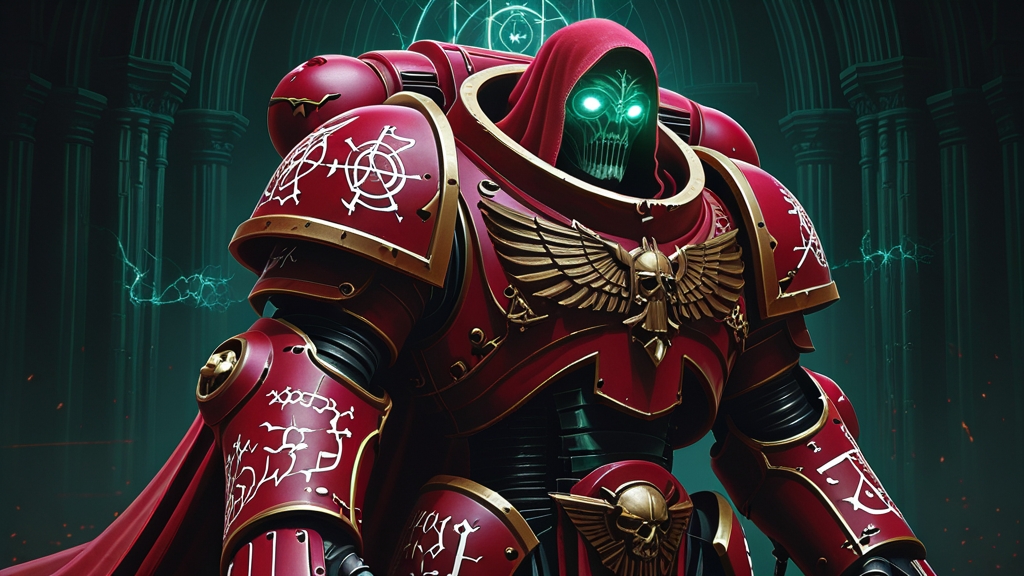
Erebus is a Word Bearers Dark Apostle who is arguably the single individual most responsible for the Horus Heresy — the galaxy-spanning civil war that nearly destroyed the Imperium of Man and set humanity on its path to the grimdark 41st Millennium. He manipulated the fall of Horus to Chaos, engineered the corruption of multiple Space Marine legions, murdered beloved characters, and orchestrated events that led to ten thousand years of war, suffering, and decay. He is universally despised by the Warhammer 40,000 community, and the phrase “fuck Erebus” has become one of the fandom’s most enduring memes.
What makes Erebus so effective as a villain — and so satisfying to hate — is that he is not a raging berserker or a cackling madman. He is a manipulator, a schemer, and a true believer. Erebus genuinely believes that the Chaos Gods are the true divinities of the universe and that his actions serve a higher purpose. He is patient, intelligent, and utterly without scruple. He does not do evil for its own sake; he does it because he believes it is necessary. This makes him far more dangerous — and far more hateable — than a straightforward villain.
What Did Erebus Do Before the Heresy?
Before the Horus Heresy, Erebus was the First Chaplain of the Word Bearers Legion — the senior religious authority within a legion defined by its religious devotion. The Word Bearers, under their Primarch Lorgar Aurelian, worshipped the Emperor as a god. They built temples, wrote scriptures, and spread the Imperial faith to every world they conquered. Erebus was central to this religious apparatus, serving as Lorgar’s chief theologian, spiritual adviser, and enforcer of doctrinal purity.
What no one knew — not even Lorgar, initially — was that Erebus had already turned to the worship of Chaos. During his early career, Erebus encountered agents of the Chaos Gods who showed him what they considered the truth: that the Warp was home to genuine gods, that the Emperor was not divine, and that the universe’s true masters dwelt in the Immaterium. Erebus was convinced, and he became one of the first Space Marines to deliberately worship the Ruinous Powers.
Erebus’s conversion to Chaos was not a sudden fall from grace. It was a calculated decision by an intelligent, ambitious man who examined the evidence available to him and concluded that the Chaos Gods were real, powerful, and worthy of worship. He then spent decades working secretly within the Word Bearers to lay the groundwork for the legion’s own conversion, planting seeds of doubt about the Emperor’s divinity and steering Lorgar toward the revelation that other gods existed.
What Role Did Erebus Play in the Destruction of Monarchia?
The Destruction of Monarchia is one of the pivotal events leading to the Horus Heresy, and while the Emperor was the one who ordered it, Erebus’s long-term manipulation helped ensure that the event would push Lorgar toward Chaos rather than toward obedience.
Monarchia was the perfect city — a metropolis built by the Word Bearers on the world of Khur as the ultimate expression of their devotion to the Emperor. Every building was a temple. Every wall bore scripture. Every citizen was a devoted worshipper. The Word Bearers considered it their masterpiece, and Lorgar saw it as proof of his legion’s purpose.
The Emperor destroyed Monarchia and ordered the entire Word Bearers legion to kneel in its ashes, censuring Lorgar for wasting time on religious devotion instead of conquering worlds. The humiliation was absolute. Lorgar was shattered by the revelation that the being he worshipped as a god not only refused to accept worship but would punish those who offered it.
Erebus was waiting for this moment. In the aftermath of Monarchia, as Lorgar spiralled into existential crisis, Erebus and his fellow conspirator Kor Phaeron guided their Primarch toward the Chaos Gods. They showed Lorgar the truth of the Warp — that real gods existed there, gods who welcomed worship. Lorgar, desperate for something to believe in, embraced this revelation. The Word Bearers became the first legion to turn to Chaos, and Erebus had engineered the conversion he had been working toward for decades.
How Did Erebus Corrupt Horus?
Erebus’s most significant act was engineering the corruption of Horus Lupercal, the Warmaster and the Emperor’s most trusted son. Without Horus’s fall, the Heresy could not have happened. And without Erebus, Horus might never have fallen.
The plan was elegant in its simplicity and devastating in its execution. Erebus stole a Kinebrach blade called the Anathame — a weapon imbued with Chaos energy — and arranged for it to be used against Horus during the campaign on Davin’s moon. Horus was mortally wounded by the poisoned blade, and as he lay dying, Erebus ensured that the Warrior Lodge (a secret society within the Sons of Horus that Erebus had helped establish) brought Horus to a Chaos temple on Davin for “healing.”
Within the temple, Horus’s spirit was projected into the Warp, where the Chaos Gods showed him carefully constructed visions of the future — a future where the Emperor would abandon the Great Crusade, build an empire of worshippers, and erase the Primarchs from history. These visions were manipulated to push Horus toward a single conclusion: the Emperor had to be stopped, and only Horus had the power to do it.
Horus emerged from the temple healed in body but corrupted in spirit. The seeds of betrayal had been planted, and they would grow into the galaxy-consuming war that followed. Every death in the Horus Heresy, every world burned, every legion broken — all of it traces back to Erebus’s scheme on Davin.
What Other Terrible Things Has Erebus Done?
The corruption of Horus would be enough to cement Erebus as one of 40k’s greatest villains, but he did not stop there. His list of crimes spans the entire Horus Heresy and beyond.
Murder of Argel Tal: Argel Tal was a Word Bearers captain and one of the most sympathetic characters in the Heresy novels. A warrior who struggled with his corruption and retained genuine honour despite his legion’s fall, Argel Tal was murdered by Erebus — stabbed in the back on the orders of the Chaos Gods, who considered Argel Tal a threat to their plans. Argel Tal’s death is one of the most emotionally devastating moments in the Horus Heresy series, and it cemented the community’s hatred of Erebus beyond redemption.
The Lodge System: Erebus was instrumental in establishing the Warrior Lodges across multiple Space Marine legions. These secret societies, ostensibly fraternal organisations for cross-legion bonding, were actually tools for spreading Chaos influence. The Lodges created networks of sympathisers and conspirators within legions that would eventually turn traitor, making the Heresy possible by ensuring that the corruption was not limited to a single legion’s leadership.
The Siege of Terra: During the climactic Siege of Terra, Erebus continued to serve as a key agent of Chaos, performing rituals, summoning daemons, and generally ensuring that the traitors’ campaign maintained its dark momentum. He survived the Heresy — unlike many of his fellow traitors — and continued to serve the Word Bearers in the millennia that followed.
Ongoing scheming: In the 10,000 years since the Heresy, Erebus has continued to operate as one of Chaos’s most effective agents. He has orchestrated wars, corrupted Imperial commanders, and advanced the cause of the Dark Gods with the same patient, methodical approach that made the Heresy possible. He has survived repeated assassination attempts, political upheavals within the Word Bearers, and the general hazards of living in the Eye of Terror for ten millennia.
Why Does Everyone Hate Erebus?
The community’s hatred of Erebus is one of the most consistent and enthusiastic sentiments in the Warhammer 40,000 fandom. “Fuck Erebus” appears on t-shirts, mugs, forum signatures, and social media posts. It transcends the usual divisions within the community — no matter what faction you play, what edition you prefer, or what aspect of the hobby you focus on, hating Erebus is a shared experience.
Several factors contribute to this universal loathing:
He’s responsible for everything bad. In a setting defined by its grimness, Erebus is arguably the root cause of the greatest disaster in human history. Without his scheming, Horus might not have fallen, the Heresy might not have happened, the Emperor might not be trapped on the Golden Throne, and the Imperium might be a functional, progressive civilisation rather than a decaying theocratic nightmare. Every time a reader encounters some new horror of the 41st Millennium, the trail of causation leads back to Erebus.
He killed Argel Tal. Of all Erebus’s crimes, the murder of Argel Tal hits the hardest because Argel Tal was genuinely likeable — a Chaos Space Marine who the reader actually cared about. Killing him through betrayal rather than honourable combat added insult to injury, and the community has never forgiven it.
He’s smug about it. Erebus does not express remorse, doubt, or regret. He believes he was right to do everything he did, and he carries himself with the self-satisfied assurance of a man who thinks he is serving the universe’s true purpose. This smugness makes him infuriating in a way that a tortured, conflicted villain would not be.
He survives. Despite being the most hated character in the setting, Erebus keeps surviving. He survived the Heresy, survived the Eye of Terror, survived ten thousand years of Chaos politics, and continues to appear in the lore as an active agent of the Dark Gods. The community wants him to die, and GW keeps not killing him, which only intensifies the hatred.
The Kharn Moment
One of the most celebrated moments in the Horus Heresy novels is Erebus’s encounter with Kharn the Betrayer. After Argel Tal’s murder, Kharn — who had been Argel Tal’s closest friend — challenged Erebus to ritual combat in the fighting pits. What followed was one of the most cathartic passages in Black Library fiction: Kharn, one of the galaxy’s greatest warriors, systematically and brutally beat Erebus to within an inch of his life.
Erebus, realising he was outmatched, attempted to teleport away using his sorcerous abilities. He succeeded, but not before Kharn had inflicted a savage beating that left Erebus humiliated and broken. The scene was celebrated across the community as Erebus finally receiving some measure of the punishment he deserved — though the fact that he escaped rather than dying only added to the frustration.
The line from the novel — “Get up” — spoken by Kharn as he beat Erebus down repeatedly, has become one of the most quoted passages in Horus Heresy fiction. It captures the community’s vicarious satisfaction at seeing the setting’s most hated character finally face consequences, even if those consequences fell short of the death everyone wanted.
Erebus in the Wider Lore
In the current 40k timeline (10,000 years after the Heresy), Erebus remains active within the Word Bearers legion. He holds the rank of Dark Apostle and continues to serve as one of the legion’s most influential figures, though his relationship with Lorgar is complicated. Lorgar has retreated into seclusion on Sicarus, the Word Bearers’ daemon world, and the legion is effectively controlled by its Dark Council — of which Erebus is a prominent member.
Erebus’s survival for ten thousand years in the Eye of Terror is itself a testament to his skill, cunning, and the favour of the Chaos Gods. The Eye of Terror is one of the most dangerous environments in the galaxy, and the internal politics of Chaos warbands are lethal. That Erebus has navigated these dangers for ten millennia — while being one of the most hated beings in a galaxy that hates intensely — speaks to his intelligence and his value to the Dark Gods.
Whether Erebus will eventually meet his end in the lore is one of the community’s most anticipated (and demanded) plot points. Every new Horus Heresy or 40k release is scrutinised for signs that Erebus’s death might finally be imminent. So far, GW has kept him alive — perhaps because a villain this effective and this hated is too valuable a narrative asset to spend. Or perhaps because keeping Erebus alive and well is, in its own way, the most grimdark outcome of all.
Frequently Asked Questions
Is Erebus the most powerful Chaos Space Marine?
No. Erebus is not the most powerful in terms of raw combat ability or psychic might. He would lose a straight fight to many other Chaos champions, as demonstrated by his beating at Kharn’s hands. His power lies in his intelligence, his patience, his political skill, and the favour of the Chaos Gods — qualities that have kept him alive and influential for longer than most warriors survive.
Could the Heresy have happened without Erebus?
This is debated. The Chaos Gods had plans to corrupt humanity regardless, and other agents (Kor Phaeron, Lorgar himself) might have eventually achieved similar results. However, Erebus was the catalyst who accelerated the timeline and connected the various strands of corruption into a coherent conspiracy. Without him, the Heresy might have been delayed, taken a different form, or failed to achieve the scale it did.
Does Erebus have any redeeming qualities?
By any conventional moral standard, no. He is a murderer, a traitor, a manipulator, and a servant of cosmic evil. However, he is undeniably intelligent, patient, and effective. If you judge him purely on competence — the ability to set goals and achieve them — he is one of the most successful characters in the setting. His goals just happen to be terrible.
Why is “fuck Erebus” such a big meme?
Because the sentiment is genuinely and universally felt. Unlike many memes, which are ironic or exaggerated, “fuck Erebus” represents the community’s real emotional response to a character who is written to be hated. The phrase has become a shibboleth — a shared expression that identifies you as part of the 40k community and signals your engagement with the setting’s lore.
Has Erebus ever faced real consequences?
The beating from Kharn is his most significant on-page consequence. He has also faced political setbacks within the Word Bearers and been outmanoeuvred by rivals on occasion. But he has never been killed, permanently diminished, or truly punished for his crimes — which is precisely why the community continues to demand his comeuppance.
Related Content
- What Is the Necroquake? — Nagash’s Great Ritual — related lore topic
- Best Warhammer Books to Read — Fiction Guide — top-rated Warhammer novels and books
- All Warhammer 40k Factions — The Complete Guide — overview of all Warhammer 40K factions
- What Is Stormcast Reforging? — The Cost of Immortality — related content on a similar topic